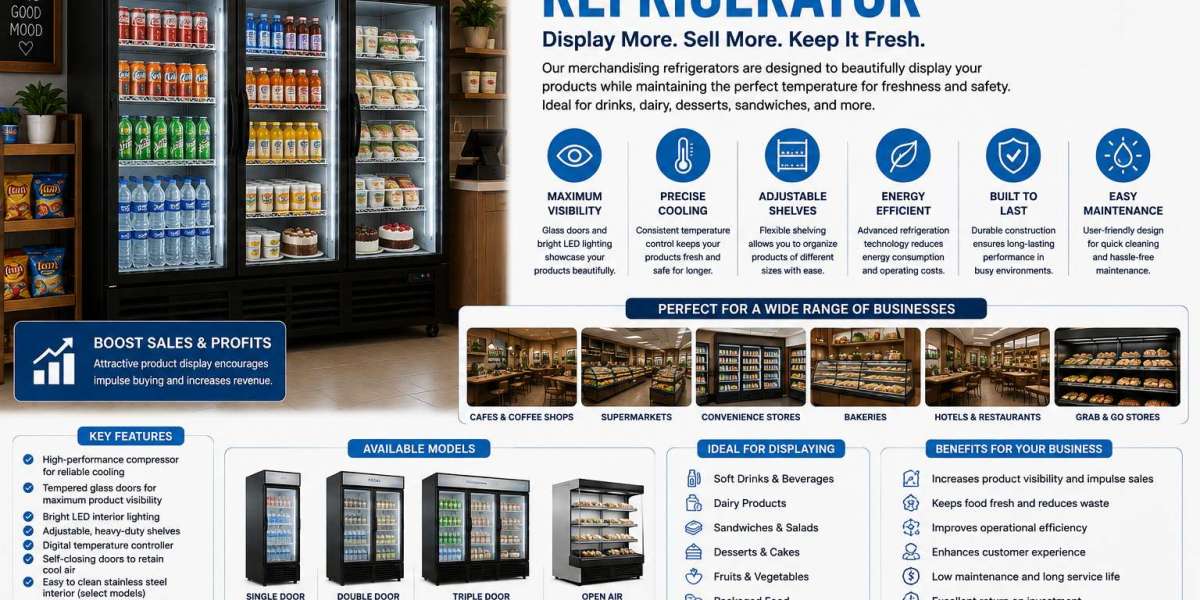

A well-designed refrigerated display can do more than keep beverages and food products cold. It can also help businesses present products attractively, improve customer visibility, organize inventory, and support faster purchasing decisions. For convenience stores, supermarkets, cafés, restaurants, bakeries, delis, hotels, and other retail food businesses, a merchandising refrigerator can be an important part of an effective sales and refrigeration strategy.
Unlike a standard commercial refrigerator designed primarily for back-of-house storage, a merchandising refrigerator is built to combine refrigeration with product presentation. Glass doors, interior lighting, adjustable shelving, and organized displays allow customers to see refrigerated products before purchasing them.
Choosing the right merchandising refrigerator requires careful consideration of capacity, dimensions, door configuration, temperature control, lighting, shelving, energy efficiency, and expected customer traffic. Businesses also need to consider the types of products they plan to display and how the refrigerator will fit into the overall store layout.
For professional commercial refrigeration solutions, The Horeca Store offers commercial merchandiser refrigerators for businesses looking to combine reliable cold storage with attractive product presentation.
What Is a Merchandising Refrigerator?
A merchandising refrigerator is a commercial refrigerated display unit designed to store and showcase temperature-sensitive products at the same time.
These refrigerators typically feature glass doors or transparent panels that allow customers to see products without opening the unit. Interior lighting and adjustable shelving can make the products easier to identify and compare.
Merchandising refrigerators are commonly used to display beverages, dairy products, packaged foods, desserts, grab-and-go meals, juices, bottled water, and other refrigerated products.
The primary difference between a merchandising refrigerator and a traditional storage refrigerator is the emphasis on customer visibility and product presentation.
Why Are Merchandising Refrigerators Important?
In retail environments, product visibility can influence customer purchasing behavior.
A customer may be more likely to notice a chilled beverage, dessert, or ready-to-eat meal when it is displayed clearly and attractively.
Improves Product Visibility
Glass doors allow customers to see products without opening the refrigerator.
This makes it easier for shoppers to identify available products and make purchasing decisions.
Creates an Attractive Display
Interior lighting and organized shelving can make refrigerated products look more appealing.
A clean, well-organized refrigerator can contribute to a professional store environment.
Keeps Products Properly Refrigerated
The refrigerator provides a controlled environment for products that require refrigeration.
Businesses should always follow the appropriate storage requirements for individual products.
Supports Grab-and-Go Sales
Merchandising refrigerators can be particularly useful for ready-to-eat products and beverages.
Customers can quickly select products without waiting for assistance.
Where Are Merchandising Refrigerators Used?
Merchandising refrigerators are versatile and can be used across many commercial environments.
Convenience Stores
Convenience stores frequently use refrigerated displays for bottled drinks, energy beverages, dairy products, sandwiches, and other grab-and-go items.
Supermarkets
Supermarkets can use merchandising refrigerators to display beverages, prepared foods, dairy products, desserts, and specialty products.
Cafés
Cafés can display bottled beverages, juices, milk-based products, desserts, sandwiches, and other refrigerated menu items.
Restaurants
Restaurants can use merchandiser refrigerators for packaged beverages, grab-and-go meals, desserts, and customer-facing refrigerated products.
Hotels
Hotels can use refrigerated displays in lobbies, cafés, breakfast areas, and convenience sections.
Bakeries and Delis
Bakeries and delis can showcase cakes, desserts, sandwiches, salads, beverages, and other products that require refrigeration.
Types of Merchandising Refrigerators
Businesses can choose from different configurations depending on their space and product requirements.
Glass-Door Merchandiser Refrigerators
Glass-door units provide excellent product visibility.
They are commonly used in customer-facing retail environments.
Single-Door Merchandising Refrigerators
Single-door models can be suitable for smaller stores or locations with limited display space.
They provide refrigerated product visibility while taking up less floor space than larger multi-door models.
Multi-Door Merchandising Refrigerators
Larger stores and high-traffic businesses may benefit from multi-door models.
They provide substantial display capacity and allow businesses to organize multiple product categories.
Upright Merchandising Refrigerators
Upright designs provide vertical storage and can maximize display capacity without requiring excessive floor space.
Counter or Compact Merchandisers
Smaller merchandising refrigerators can be useful for cafés, small retail stores, checkout areas, and businesses with limited space.
Key Features to Consider
When choosing a merchandising refrigerator, businesses should evaluate several features.
Glass Door Design
Glass doors are one of the most important features because they allow customers to see the products.
Look for a design that provides good visibility while supporting efficient operation.
Interior Lighting
LED lighting can help illuminate products and make labels and packaging easier to see.
Good lighting can improve both customer browsing and employee inventory checks.
Adjustable Shelving
Adjustable shelves allow businesses to modify the display according to product size and inventory requirements.
This is especially useful for stores that carry different products throughout the year.
Temperature Control
Reliable temperature control is essential for refrigerated products.
Businesses should select a refrigerator suitable for the temperature requirements of the products being stored.
Digital controls can make temperature monitoring more convenient.
Storage Capacity
Consider how many products you need to display.
A refrigerator should provide enough capacity for normal and peak inventory without overcrowding.
Durable Construction
Commercial merchandising refrigerators are used frequently in busy environments.
Durable construction can help them withstand regular loading, unloading, cleaning, and customer interaction.
How to Choose the Right Merchandising Refrigerator
Choosing the right refrigerator starts with identifying your business requirements.
Determine What You Will Display
Different products require different types of storage.
Beverage bottles may need taller shelves, while packaged meals and desserts may require wider shelves.
Make a list of the products you intend to display before selecting a unit.
Measure Your Available Space
Measure the intended installation area carefully.
Consider width, depth, height, door clearance, customer traffic, employee access, and nearby equipment.
The refrigerator should fit naturally into the store layout.
Estimate Customer Demand
High-traffic locations may need larger display capacity.
Consider average sales volume as well as peak periods, holidays, weekends, and seasonal demand.
Consider Product Accessibility
Frequently purchased products should be easy for customers to see and retrieve.
Arrange shelves according to product popularity and size.
Merchandising Refrigerator vs. Standard Commercial Refrigerator
A standard commercial refrigerator is primarily designed for storage.
A merchandising refrigerator is designed for both storage and presentation.
For example, a restaurant may use a large reach-in refrigerator in its kitchen for bulk ingredients while placing a glass-door merchandising refrigerator in the dining area or front counter for beverages and grab-and-go products.
The choice depends on the purpose of the refrigerator.
If customers need to see the products, a merchandiser can provide an advantage.
If the unit is only for employee-accessed storage, a standard commercial refrigerator may be more appropriate.
How to Organize a Merchandising Refrigerator
Good organization can improve the effectiveness of a refrigerated display.
Place popular products at convenient eye-level positions.
Group similar products together.
Keep labels facing forward.
Avoid overcrowding shelves.
Maintain sufficient space for employees to restock products.
Use consistent product placement so customers can easily find their preferred items.
Rotate inventory according to appropriate stock-management procedures.
Regularly check product dates and remove products that are no longer suitable for sale.
A clean and organized display can make the refrigerator easier to shop and maintain.
Cleaning and Maintenance
Regular cleaning is essential for merchandising refrigerators.
Clean glass doors frequently so customers can clearly see products.
Wipe shelves and interior surfaces according to manufacturer recommendations.
Remove spills immediately.
Inspect door gaskets for damage or wear.
Keep condenser and ventilation areas clean according to manufacturer instructions.
Monitor temperatures regularly.
Check interior lighting and replace components when necessary.
If the refrigerator develops unusual noises, inconsistent cooling, excessive condensation, or other problems, professional servicing may be required.
Energy Efficiency Considerations
Because merchandising refrigerators can operate continuously, energy efficiency can affect long-term operating expenses.
Businesses should consider the refrigerator's insulation, door design, lighting, refrigeration system, and operating specifications.
Keep doors closed when appropriate and avoid unnecessary openings.
Do not overload shelves.
Maintain proper ventilation and installation clearances.
Regular maintenance can help support efficient refrigeration performance.
Businesses should compare both initial purchase cost and long-term operating expenses when selecting equipment.
Common Mistakes to Avoid
One common mistake is choosing a merchandising refrigerator based only on appearance.
A visually attractive refrigerator still needs to provide appropriate capacity, temperature control, durability, and functionality.
Another mistake is choosing a unit that is too small for peak inventory.
Overcrowding can make products difficult to see and retrieve.
Poor product arrangement can also reduce the effectiveness of the display.
Businesses should avoid blocking ventilation areas or ignoring manufacturer installation requirements.
Finally, neglecting cleaning and maintenance can negatively affect both product presentation and equipment performance.
Benefits of Choosing The Horeca Store
Finding the right commercial refrigeration equipment is easier when businesses can compare solutions designed for professional environments.
The Horeca Store provides commercial refrigeration equipment for restaurants, supermarkets, convenience stores, cafés, hotels, bakeries, delis, and other businesses.
Businesses searching for a merchandising refrigerator can explore commercial merchandiser refrigerator options based on storage capacity, product type, display requirements, available space, and operational needs.
Explore commercial merchandising refrigerators at The Horeca Store
Whether you need a compact unit for a small café or a larger refrigerated display for a busy retail location, selecting equipment based on actual business requirements can help maximize both storage and display potential.
Is a Merchandising Refrigerator Worth the Investment?
For businesses that sell refrigerated products directly to customers, a merchandising refrigerator can be a valuable investment.
It provides cold storage while making products visible and accessible.
This combination can support grab-and-go sales, improve store organization, and create a professional product display.
However, the right model depends on product type, customer traffic, available floor space, storage capacity, energy consumption, and maintenance requirements.
Businesses should evaluate these factors before purchasing.
Conclusion
A merchandising refrigerator is an effective commercial refrigeration solution for businesses that want to combine product storage with customer-facing presentation.
Convenience stores, supermarkets, restaurants, cafés, hotels, bakeries, delis, and other retail food businesses can use merchandising refrigerators to display beverages, packaged foods, desserts, grab-and-go meals, and other refrigerated products.
When selecting a unit, consider glass-door visibility, interior lighting, shelving, temperature control, capacity, dimensions, construction, energy efficiency, and maintenance.
Proper organization is equally important. Keep products clearly grouped, labels facing forward, shelves clean, and inventory properly rotated.
For businesses searching for professional refrigerated display equipment, The Horeca Store offers commercial merchandiser refrigerator solutions for a range of business applications.
Shop commercial merchandiser refrigerators from The Horeca Store
With the right merchandising refrigerator, businesses can create an attractive refrigerated display, improve product accessibility, organize inventory, and provide customers with a convenient shopping experience.