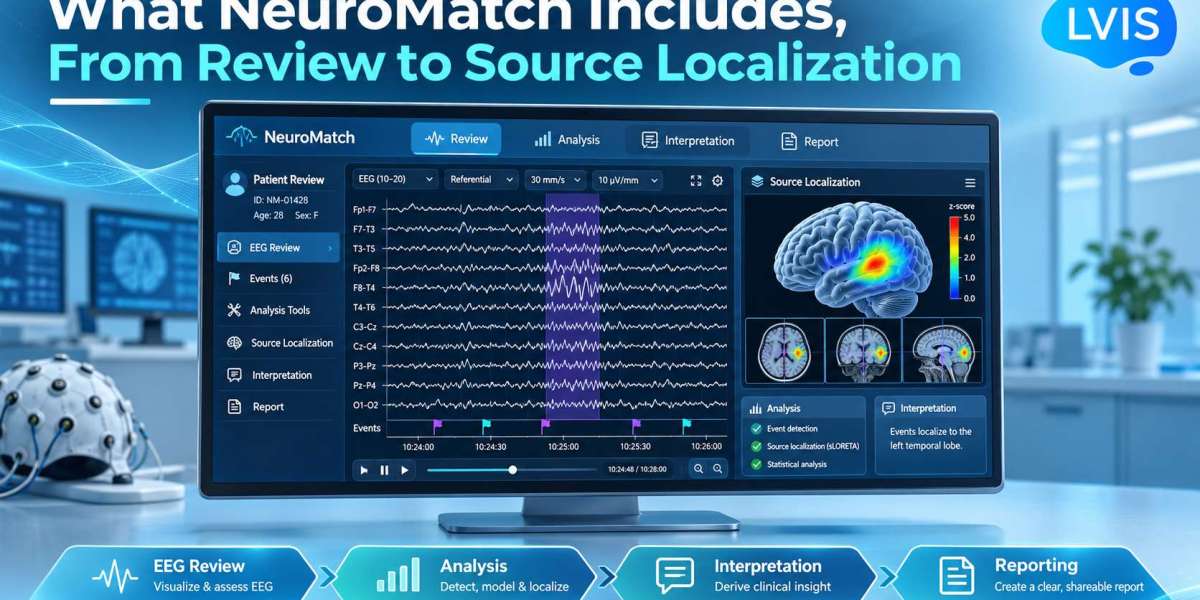

NeuroMatch® brings EEG review, reporting, detection, and source localization into one cloud based platform, with advanced pay per use options available when a case calls for them.
Departments evaluating the platform benefit from understanding how those pieces fit together, because the question is usually not which capabilities exist. It is which ones matter most for this unit's workflow.
The Platform Layer
The starting point is the platform itself: EEG recordings uploaded to the cloud, studies reached through a web browser rather than from designated reader stations, reports produced within the platform, and studies archived in the NeuroMatch® data library.
For a department whose primary constraint is access rather than analysis, this is the layer that matters. Physicians access EEG files anytime, anywhere from a web browser. Multi physician collaboration means clinicians can work together remotely as if they were sitting together in the same room. Automated reports consolidate daily reports created by multiple physicians. Longitudinal reports enable incremental comparisons between studies.
Departments should confirm the exact feature set with LVIS during evaluation, since configurations can differ by market and by regulatory clearance.
Automated Detection
Automated event detection builds on that foundation, and this is where the platform starts changing how long a read takes.
Spike detection identifies spikes, which are markers used in diagnosing and managing epilepsy. Seizure detection uses deep learning algorithms to identify seizure events automatically, validated through thousands of hours of nineteen channel EEG data, with the system notifying physicians of detected seizures within an hour.
Both features are FDA cleared for clinical use. Both present candidates rather than conclusions, and physicians retain the ability to review, validate, or adjust detected events based on their clinical expertise.
The case for detection is straightforward in units running long term monitoring. Physicians otherwise invest hours reviewing thousands of EEG pages to deduce when and where events originate. Tabulated candidate events change where that time goes.
Source Localization
Source localization extends the platform toward the question of where activity originates rather than only whether it occurred.
Spike source localization lets clinicians pinpoint the origin of spikes in the source space within a three dimensional brain and MRI template. Seizure source localization lets clinicians inspect source localized seizure activity mapped onto a three dimensional brain.
The clinical framing LVIS has used for this is precise. Detailed seizure network analysis has often required costly, time consuming procedures or invasive testing. NeuroMatch offers non invasive mapping tools within a clinician's existing workflow, which supports evaluation of patients with treatment resistant epilepsy and those being considered for surgical interventions such as resection, ablation, or stereo EEG guided planning.
Advanced pay per use options sit alongside this. Spike source localization trends compare dominant spikes from each spike group by anatomical region per hemisphere. Seizure source localization trends provide insight into the onset and evolution of seizure activity across the brain in four dimensional playback.
Certain features are not cleared in every market. Hospitals should confirm the regulatory status of any specific capability with LVIS before relying on it clinically.
How Departments Tend to Use It
Which capabilities a unit leans on usually follows from what it is currently constrained by.
Departments whose main problem is access, coverage, or reader station dependency get most of their value from the platform layer. Physicians who cannot reach studies from where they are will not benefit much from better analysis until that is solved.
Departments running high volume long term monitoring, where the read time itself is the bottleneck, get the most from automated detection, which addresses the search problem directly.
Departments doing presurgical evaluation, or referring patients elsewhere for it, are the ones for whom source localization and the pay per use trend options are relevant. Source localization contributes to a specific clinical question that most routine EEG does not raise.
Many units find the platform's role grows as their clinical needs develop.
Included Across the Platform
Certain things are properties of the platform regardless of how a unit uses it.
Studies are uploaded to the cloud and reached through a browser. Role based access controls manage permissions. The hosting environment adheres to the required administrative, physical, and technical safeguards mandated by HIPAA regulations, including file integrity scans, multi factor authentication, a fully managed firewall, and network edge protection.
Artifact reduction is FDA cleared to reduce muscle and eye artifacts, though it does not remove them entirely and does not address other artifact types. Twenty four hour trending summaries offer a comprehensive daily overview of trending results. The platform is backed by a one hundred percent uptime service level agreement.
Behind the platform, LVIS Corporation holds ISO 13485 certification, which covers its quality management system across design, development, and manufacturing.
The Regulatory Position
NeuroMatch® has received regulatory clearance in the United States and Korea, under FDA clearance number K250239 and MFDS license number 23-4685.
Departments should confirm which specific capabilities are cleared in their market as part of evaluation. This is not a formality. Clearance applies to particular functions rather than to a product name, and the answer determines what the unit can rely on clinically.
Questions Worth Asking During Evaluation
Which capabilities match the constraint this unit is actually facing?
Which of those capabilities are cleared for clinical use here?
What does implementation involve, and what does it cost?
Which options are pay per use rather than included?
Does the configuration differ by market?
How does the platform's access and security model apply to this unit's setup?
The Practical Summary
LVIS NeuroMatch® () brings cloud based review and reporting, FDA cleared spike and seizure detection, and source localization for more complex epilepsy evaluation into one platform, with advanced pay per use options when they are needed.
Getting value from it usually means being honest about which bottleneck the unit is currently living with rather than planning for a workflow it does not yet have.
To discuss how NeuroMatch fits your department's workflow, request a demo.