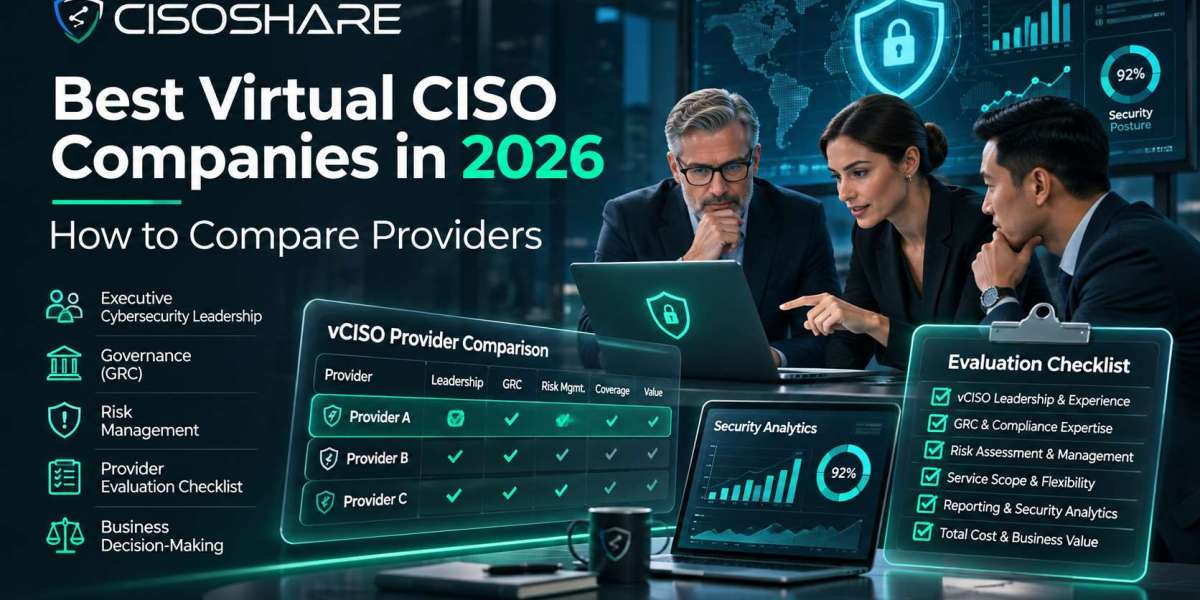

Choosing a virtual Chief Information Security Officer is a significant decision for organizations that need cybersecurity leadership without hiring a permanent executive. The provider must understand business risk, communicate effectively with leadership, and help translate security priorities into practical work. Companies comparing outsourced ciso services should look beyond monthly fees and advertised expertise to understand what the engagement actually delivers. The strongest choice depends on existing security resources, industry obligations, executive expectations, and the support needed to implement recommendations. This updated CISOSHARE guide explains how to assess providers, compare engagement models, and create a shortlist based on documented capabilities rather than promotional rankings.
Why Are Organizations Comparing Virtual CISO Providers in 2026?
Cybersecurity leadership now involves more than responding to technical incidents or maintaining security policies. Organizations must address customer security questionnaires, regulatory expectations, third-party risks, emerging threats, and executive concerns about business continuity. Smaller and midsize businesses may have capable IT teams without an experienced executive responsible for an integrated security program. Different vCISO companies address this gap through advisory engagements, recurring leadership services, or broader security program management. The right model should support measurable improvements without adding unnecessary complexity or creating responsibilities that internal teams cannot fulfill.
What Is the Difference Between a vCISO and CISO-as-a-Service?
A virtual CISO generally provides senior-level cybersecurity leadership through a contractual arrangement rather than direct full-time employment. Responsibilities may include governance, risk assessment, security strategy, executive reporting, and coordination of existing resources. CISO-as-a-Service may offer a wider delivery model that combines leadership with supporting professionals who help build and operate the security program. CISOSHARE explicitly distinguishes these options in its published service offering, allowing businesses to consider leadership alone or leadership supported by an implementation team. Buyers should confirm the actual scope because terminology and delivery models vary among providers.
How to Choose a vCISO Provider Based on Business Requirements
The first step is to identify what the organization cannot currently accomplish with its existing personnel and resources. Some businesses need an executive to review strategy and communicate risk, while others need hands-on program development and operational support. A provider should understand important customer commitments, industry obligations, technology dependencies, and executive reporting requirements before proposing a solution. The evaluation should also establish who will own implementation, approve decisions, and respond when new risks emerge. Clear requirements make quotations easier to compare and prevent the lowest advertised fee from becoming the only selection criterion.
1. Assess Executive Cybersecurity Experience
The assigned professional should have experience leading security programs and communicating with business executives. Technical qualifications are valuable, but a senior security leader must also understand budgets, governance, priorities, and business risk acceptance. Ask which types of organizations the professional has supported and whether that experience is relevant to your environment. Request examples of strategic roadmaps, management reporting, and security program improvements with sensitive information appropriately removed. A provider's company-wide expertise should not be confused with the qualifications of the individual who will actually lead your engagement.
2. Check Industry and Compliance Experience
Healthcare providers, financial services businesses, SaaS companies, nonprofits, and government contractors can face substantially different requirements. Relevant experience may include HIPAA, SOC 2, ISO 27001, CMMC, or other frameworks appropriate to the organization's actual obligations. A provider should explain the difference between preparing for an assessment and guaranteeing a successful audit or certification. It should also recognize when specialist legal, technical, or independent assessment expertise is necessary. The best match is a provider familiar with the organization's real risks rather than one that simply lists the largest number of compliance frameworks.
3. Confirm Implementation Responsibilities
A strategy without execution capacity may leave an organization with more documentation but limited security improvement. Ask whether the provider will create policies, coordinate assessments, maintain risk registers, oversee remediation, and support relevant program activities. Determine which tasks remain with internal IT personnel and which require additional external resources. Some engagements deliberately provide leadership only, which can work well when the organization already has sufficient implementation capability. Problems arise when the buyer expects operational delivery but the agreement includes only meetings and recommendations.
4. Review Availability and Incident Escalation
An outsourced security leader may not be available on the same schedule as a permanent executive. Organizations should agree on regular meeting frequency, contact methods, response expectations, and escalation arrangements for urgent matters. The contract should clarify whether incident response coordination, after-hours availability, and technical response services are included. It should also explain what happens when the primary consultant is unavailable or the workload increases unexpectedly. Defined availability helps executives understand the service they are buying without assuming the arrangement provides round-the-clock coverage.
5. Evaluate Team Depth and Continuity
A named senior consultant can bring valuable experience, but the relationship may become vulnerable if all knowledge rests with one person. Ask whether the provider offers backup leadership, security specialists, compliance support, and documented continuity procedures. Confirm that policies, roadmaps, risk records, and working documents remain accessible to the organization. Additional personnel should have clearly assigned responsibilities rather than exist only as names in a sales presentation. A strong continuity approach protects the security program when staff change or the engagement ends.
6. Compare Reporting and Program Outcomes
Executive stakeholders need to understand which risks matter, what work has been completed, and which decisions remain unresolved. Useful reporting may address control implementation, vulnerability remediation, third-party assessments, audit readiness, and important security program milestones. Providers should distinguish completed activities from meaningful reductions in business risk. Ask for an example reporting format and discuss how progress will be reviewed with the appropriate management team. The chosen measurements should reflect the organization's objectives rather than a standardized dashboard that adds little decision-making value.
7. Understand the Commercial Terms
A proposal should identify the services, assigned personnel, engagement duration, fees, and conditions for changing the scope. It should also define deliverables, confidentiality requirements, termination provisions, and ownership of work products. Buyers need to understand how additional hours, specialist work, and incident-related requests will be charged. Comparing contracts with different inclusions solely by their monthly price can produce misleading conclusions. The relevant question is whether the proposed arrangement provides sufficient leadership and execution support for the total financial commitment.
Ten Providers to Consider When Building a 2026 Shortlist
The following organizations appeared in CISOSHARE's original 2026 provider comparison and represent different approaches to security leadership and supporting services. Their inclusion is intended to provide research starting points rather than an independently verified ranking of current provider performance. Service availability, assigned personnel, pricing, and contractual arrangements may change and must be confirmed directly before procurement. Buyers should evaluate each organization using the same requirements instead of assuming a numbered list establishes superiority. The most suitable provider will depend on the organization's security maturity, industry, internal staffing, and expected operating model.
CISOSHARE – Strategic Leadership and Security Program Execution
CISOSHARE offers a virtual leadership arrangement for organizations that need an experienced security executive to guide existing teams. Its broader CISO-as-a-Service option combines strategic leadership with additional resources for building, implementing, and managing security activities. The published scope includes governance, documentation, vulnerability and risk management, and third-party assessments. This distinction may be particularly relevant to businesses that need more than executive advice but do not want to build every security function internally. Buyers should confirm the level of personnel support, specific deliverables, and responsibilities included in their proposed engagement.
FRSecure – Risk Assessment and Security Program Guidance
FRSecure was included in CISOSHARE's original comparison as a provider associated with risk-assessment-led security services. Organizations considering this approach should ask how initial findings become prioritized remediation work and ongoing governance activities. The evaluation should clarify whether the engagement includes executive leadership, supporting security specialists, or separate managed services. Buyers should also request details about assigned personnel, reporting frequency, and implementation responsibilities. Current offerings and commercial terms should be verified directly with the provider.
Compass IT Compliance – Compliance and Risk-Focused Support
Compass IT Compliance appeared in the original shortlist as an option for organizations with substantial compliance and security assessment requirements. Buyers should examine the provider's relevant experience with their specific regulatory or contractual obligations. It is important to distinguish advisory support, audit preparation, independent assessment work, and ongoing program ownership. The proposal should clarify how identified gaps are assigned to accountable teams and how progress is reported. A strong fit depends on the organization's actual compliance challenges rather than a general claim of framework coverage.
SideChannel – Security Leadership for Growing Organizations
SideChannel was included in the original article as a provider relevant to organizations developing or expanding their security programs. Growing businesses should ask whether the engagement can adapt as headcount, infrastructure, and customer requirements change. They should also assess how the external leader collaborates with founders, technical managers, and future internal security personnel. Clear handover expectations are valuable when a company eventually decides to hire its own security executive. Buyers should verify current service options and the resources assigned to the engagement before making a decision.
Cynomi – Technology-Enabled Security Program Management
Cynomi represents a technology-oriented approach to supporting cybersecurity assessments, planning, and program management. Buyers should determine whether they are purchasing a software platform, a human-led security leadership service, or a combination delivered through a partner. Automated documentation and assessment workflows can improve efficiency, but they do not eliminate the need for professional judgment and executive accountability. The organization should confirm who validates recommendations, oversees implementation, and communicates risks to management. A platform-led approach is most useful when its responsibilities and limitations are understood.
Optiv – Broader Cybersecurity Advisory Resources
Optiv was included in the original comparison as an option associated with extensive cybersecurity advisory and specialist capabilities. Organizations with complex environments may value access to multiple technical disciplines alongside strategic leadership. However, the breadth of an organization does not establish which specialists will be available under a specific contract. Procurement teams should confirm the assigned executive, supporting resources, and whether additional services require separate engagements. The proposal should match the complexity of the organization's security needs rather than simply emphasize provider size.
DeepSeas – Security Operations and Strategic Oversight
DeepSeas appeared in the original provider list with an emphasis on security operations and technology-supported services. Buyers should investigate how any operational security capabilities connect with executive governance and risk reporting. A managed detection service does not automatically replace the responsibilities of a senior information security leader. The agreement should explain which personnel oversee security strategy, who handles incidents, and how recommendations reach executive stakeholders. These distinctions matter for businesses seeking coordinated leadership rather than disconnected security tools.
Kroll – Incident Expertise and Security Advisory
Kroll appeared in the original comparison as an option associated with incident response and investigative cybersecurity expertise. Organizations with significant incident readiness concerns may want to explore how this experience informs broader security planning. However, incident investigation, ongoing security operations, and virtual executive leadership are different service responsibilities. Buyers should establish the scope of routine governance support and the terms under which specialist incident services can be accessed. The engagement should be evaluated according to the organization's expected requirements and available internal resources.
Fractional CISO – Dedicated Outsourced Leadership
Fractional CISO was included in the original article as a provider focused on part-time security leadership and compliance-related support. Buyers should clarify whether the assigned leader works independently or has additional analysts and specialists available. They should also investigate how the service handles customer assessments, ongoing governance tasks, and implementation coordination. The financial structure should reflect the expected level of involvement and the complexity of the organization's security environment. Provider-specific claims about staffing or commercial arrangements should be confirmed during procurement.
Navisite – Broader IT and Cybersecurity Support
Navisite appeared in the original shortlist as an organization offering cybersecurity expertise alongside broader technology services. Businesses considering an integrated provider should clarify how strategic security leadership interacts with existing infrastructure and IT management responsibilities. The contract should identify any potential overlap between advisory work, managed technology services, and security program execution. Buyers should also understand who holds authority for risk decisions and how security issues are escalated. Current leadership offerings and support arrangements should be verified directly before selecting a provider.
How to Compare Outsourced CISO Services Without Misleading Rankings
Comparing outsourced ciso services requires a consistent assessment of people, deliverables, operating responsibilities, and commercial terms. A company that provides limited executive advice should not be compared directly with a team delivering daily security program operations without adjusting for scope. Buyers can create a weighted evaluation based on their own priorities, such as regulatory expertise, implementation support, availability, and reporting. Each provider should receive the same questions and have an opportunity to explain exclusions or assumptions. A structured comparison creates a more defensible decision than relying on an article that labels one provider the best without explaining the basis.
Use a Standard Provider Evaluation Checklist
A practical evaluation should assess expertise, delivery capacity, industry fit, executive communication, security program processes, continuity, and financial transparency. CISOSHARE's 7-point provider checklist offers a more detailed starting point for discussing these requirements. Buyers should request evidence for claims and record which responsibilities are included in writing. The same evaluation criteria should be applied to every shortlisted organization, including CISOSHARE. This helps management identify meaningful differences instead of being influenced by persuasive sales language alone.
How Do vCISO Pricing Models Work?
Different engagements may use a monthly retainer, a project fee, or a combination of fixed and variable charges. Retainers can support recurring governance work, while project arrangements may fit a defined assessment or program-development assignment. Hybrid contracts can combine ongoing leadership with additional services that are priced separately. CISOSHARE's guide to vCISO pricing models explains the distinction between retainer, project, and hybrid arrangements. Each model should be evaluated against workload, predictability, implementation requirements, and the cost of work outside the agreed scope.
Why Is a Lower Monthly Fee Not Always Better?
A low-priced agreement may provide limited hours, infrequent meetings, or advisory work without implementation support. The organization may then need additional personnel or separate consulting engagements to act on the recommendations. A more expensive proposal may include greater capacity, but that does not automatically make it better value. Buyers should compare the total expected cost of obtaining an effective security program, including internal staff time and external specialist resources. Fees should be evaluated alongside actual deliverables and the ability to meet business requirements.
What Should Your vCISO Contract Include?
The agreement should identify the assigned leader and the organization's responsibilities for governance and execution. It should define meeting cadence, deliverables, reporting, confidentiality obligations, access requirements, and relevant escalation procedures. Any supporting engineers, analysts, or compliance specialists should have their responsibilities documented. The contract should also explain how changes, emergencies, renewals, and termination will be handled. Clear terms reduce the likelihood of disagreements about what the provider is expected to deliver.
How Should Knowledge Transfer Be Managed?
An outsourced security program should leave the organization with usable documentation and clear ownership of important work products. Policies, security roadmaps, risk registers, and decision records should remain accessible to authorized company personnel. The provider should explain how it will transfer knowledge if the engagement ends or an internal CISO is hired. This is particularly important when the service relies heavily on a single named professional. Continuity arrangements should be assessed before signing rather than only when a transition becomes necessary.
What Results Should You Expect in the First 90 Days?
A realistic initial engagement should establish the organization's most important business requirements and current security responsibilities. The assigned leader may interview stakeholders, review existing documentation, assess maturity, and identify urgent risks. The resulting roadmap should describe priorities, accountable owners, dependencies, and appropriate measures of progress. Implementation activities should then begin according to the agreed scope and the resources available. Ninety days can establish direction and momentum, but a complete security program may require a longer period.
How Should Executive Leadership Evaluate Progress?
Business leaders should receive reporting that distinguishes significant risks from routine operational activity. Useful measures may include progress on remediation, completed assessments, unresolved governance decisions, and important compliance preparation tasks. Reports should explain where management approval or additional resources are necessary. They should not treat the number of meetings or generated documents as automatic evidence of improved security. Leadership needs to understand whether the program is becoming more consistent, accountable, and responsive to business requirements.
How Do You Choose Between a Solo Consultant and a Security Team?
A solo consultant may be sufficient when an organization already has capable people responsible for implementing security controls. A broader service can be more appropriate when the business also needs support with documentation, assessments, remediation coordination, and program administration. The provider should explain whether it supplies these activities directly or expects the organization to arrange them elsewhere. Organizations should avoid paying for unnecessary staffing while also avoiding an advisory-only arrangement that leaves critical work undone. The correct model depends on the available internal capacity and the complexity of the security program.
How Does CISOSHARE Approach Virtual Security Leadership?
CISOSHARE distinguishes strategic vCISO support from a broader CISO-as-a-Service model that includes security program resources. Its published capabilities address governance, security documentation, vulnerability and risk management, and third-party assessments. The company also positions security program development as a way to address customer requirements and support business operations. Organizations considering its services should explain their current maturity, staffing constraints, and primary security priorities. The proposed scope should then be reviewed against the same criteria used to evaluate other providers.
Frequently Asked Questions
Which Virtual CISO Companies Are Best for Small Businesses?
The answer depends on the business's security requirements, internal personnel, and budget. A smaller organization with competent IT staff may need strategic oversight rather than a large supporting team. Another business may require assistance building foundational security processes alongside executive leadership. Buyers should compare actual services and assigned resources rather than rely on a provider's placement in a promotional list. A suitable contract should reflect the company's capacity to implement the agreed roadmap.
What Is the Biggest Mistake When Selecting a vCISO?
One common mistake is assuming that strategic leadership includes technical implementation and ongoing operational work. A provider may deliver helpful recommendations while the organization lacks personnel to carry them out. This can result in delays, unclear ownership, and limited progress despite regular meetings. Buyers should ask for detailed deliverables and a clear division of responsibilities before committing. The agreement must explain who is accountable for moving security recommendations into operational practice.
Can a vCISO Help With SOC 2, ISO 27001, or CMMC?
A vCISO can help organize governance, risk assessments, documentation, and preparation relevant to applicable security frameworks. However, the precise requirements vary by framework, organization, and assessment scope. Independent auditors and certification or assessment bodies retain their respective evaluation responsibilities. No responsible provider should guarantee certification or a successful audit simply because an engagement has begun. The proposal should describe the preparation activities and supporting resources that are actually included.
How to Choose a vCISO Provider When You Already Have an IT Team?
Start by identifying which cybersecurity leadership responsibilities your existing IT team cannot reasonably fulfill. Evaluate whether the provider can establish security priorities, guide risk decisions, and report effectively to executive management. Confirm that the engagement will integrate with internal personnel without creating conflicting authority or duplicated work. A leadership-focused arrangement may be adequate when implementation resources are already available. The organization should still document accountability and continuity arrangements before work begins.
Are Virtual CISO Companies More Affordable Than Hiring a Full-Time CISO?
An outsourced arrangement can reduce the need for a permanent executive salary and related employment expenses. However, total cost depends on engagement scope, supporting personnel, additional projects, and the duration of the relationship. A business that needs extensive day-to-day program execution may spend more than the advertised advisory fee. Cost savings should therefore be evaluated against the complete operating model rather than an isolated monthly rate. The decision should balance affordability with the ability to meet the organization's actual security responsibilities.
Conclusion – Select a Provider Based on Execution, Not Rankings
The best provider is not necessarily the most recognizable company or the one appearing first in a sponsored comparison. Organizations comparing vCISO companies should assess assigned leadership, implementation capacity, industry experience, availability, reporting, and contract terms. Well-scoped outsourced ciso services can provide strategic direction and support security program improvements without requiring every organization to employ a permanent executive. CISOSHARE offers both leadership-focused and broader security program options for businesses evaluating these needs. To discuss your organization's requirements, schedule a call and review which service model fits your current capabilities and priorities.