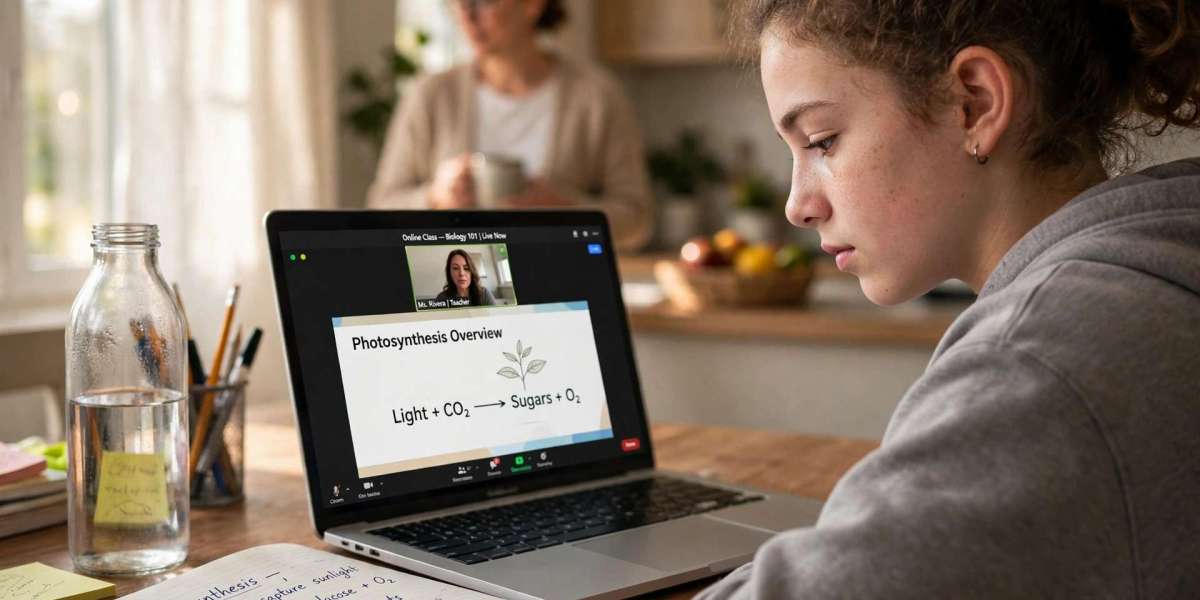

Five years ago, after-school tutoring in the Gulf usually meant a drive across town, a waiting room, and a fixed timetable that the whole family had to bend around. Today, a growing share of professional families in the UAE and across the region skip the drive entirely. The lesson happens at the kitchen table or the study desk, the tutor arrives by video call, and the schedule is built around the family's day rather than the other way round. One-to-one online tutoring has quietly become the default, and the reasons are practical rather than fashionable.
The Commute Was the First Thing to Go
For working parents, the hardest part of traditional tutoring was rarely the teaching. It was the logistics: leaving work early, crossing the city in evening traffic, and getting home again before dinner. Online lessons remove that entire layer. A student finishes school, has a snack, and is in a lesson minutes later, with no parent acting as a driver. For families split between home and office schedules, that saving of time is what made the switch permanent rather than temporary.
Scheduling Around Work, Not Against It
Professional households in the Gulf run on tight calendars, and children are often balancing school with sports, music, and family commitments. A one-to-one online lesson can be booked at the hour that actually suits the student, moved when a work trip or a school event intervenes, and paused or intensified around exam periods. That flexibility is difficult for a physical centre with fixed group batches to match. When the lesson fits the week instead of fighting it, students attend more consistently, and consistency is what turns tutoring into results.
Matching Matters More Than Location
In a neighbourhood centre, a student gets whichever tutor is available. Online, the match can be made on the things that actually affect learning: the curriculum, the subject, the exam board, and the student's level. Services such as Combo Tutors Academy match students one-to-one across IGCSE, GCSE, A Level and IB programmes, in subjects including Maths, Physics, Chemistry, Biology, English and Computer Science. For many Gulf families, the curriculum match is the deciding factor, because a tutor who knows the exact syllabus and paper structure teaches differently from a generalist. Female tutors are also available on request, which matters to many households in the region.
Trial-First Buying Changed the Decision
Tutoring used to be bought on reputation and hope, paid for a term in advance. The online model changed the buying pattern. A free trial lesson, typically 30 minutes, lets the student and parent judge the teaching before any commitment. If the tutor is not a fit, a free rematch means the family is not locked into a mismatch for the rest of the term. That trial-first structure, which Combo Tutors Academy has offered alongside its lessons since 2020, lowers the risk of starting and makes parents far more willing to begin early in the term rather than waiting for a crisis before exams.
Transparent Hourly Cost
The economics are easier to read as well. Instead of term fees bundled with registration charges and materials, online tutoring is usually priced by the hour, with lessons from $15/hour making the cost of each week simple to calculate and compare. Parents can increase hours in the run-up to exams and reduce them in quieter months, paying for teaching time rather than for a package. For budget-conscious professional families, that transparency is a genuine part of the appeal.
What Has Not Changed
The technology changed the delivery, not the fundamentals. Students still need a qualified tutor, a plan matched to their syllabus, and regular feedback to parents. What online tutoring removed was the friction around those essentials: the travel, the rigid timetable, the advance commitment, and the unclear pricing. That is why, for busy Gulf families, the video-call lesson is no longer the backup option. It is simply how after-school tutoring works now.
FAQ
Which curricula can one-to-one online tutors cover?
Tutors can be matched to IGCSE, GCSE, A Level and IB programmes, across subjects such as Maths, Physics, Chemistry, Biology, English and Computer Science, so the teaching follows the student's exact syllabus and exam board.
How does a free trial lesson work?
The student takes a real lesson, usually 30 minutes, with the matched tutor before paying anything. Parents can judge the teaching style and the fit, and if the tutor is not right, a free rematch with a different tutor is available.
What does online tutoring cost in the Gulf?
Pricing is typically hourly and transparent. Combo Tutors Academy's lessons start from $15/hour, so families can scale hours up before exams and down in quieter months instead of paying fixed term packages.