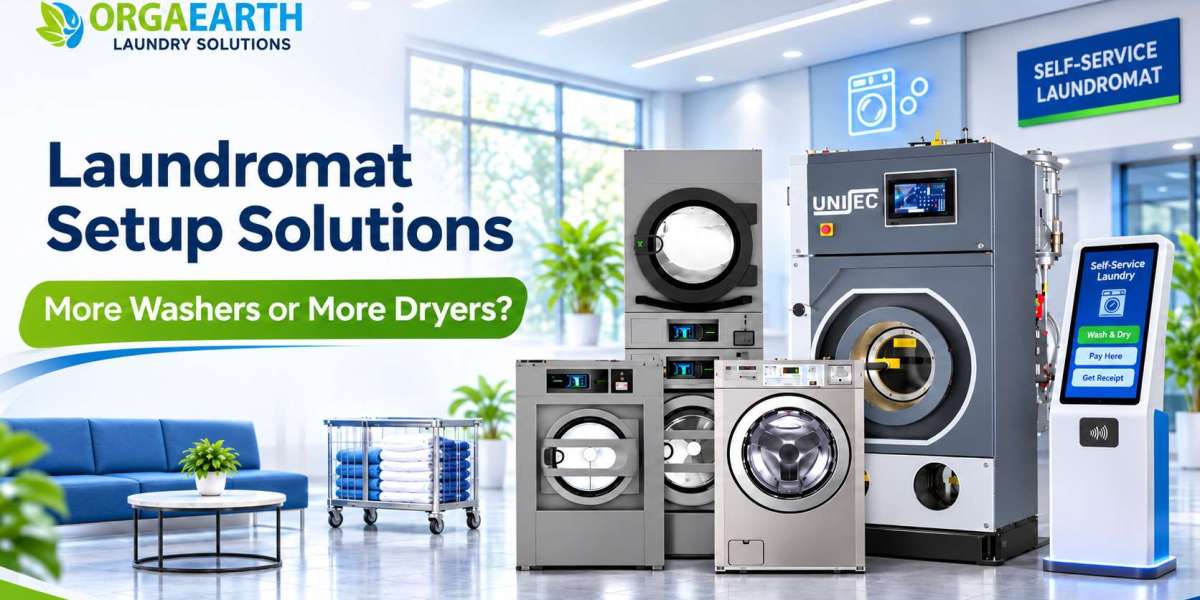

Planning to start a laundromat business in India but unsure how many washing machines and dryers you should purchase?
Imagine investing in four commercial washing machines and only one dryer. Customers can wash their clothes quickly, but they must wait for the dryer to become available.
Now consider the opposite situation. You install several dryers, but your washing machines cannot generate enough laundry to keep them occupied.
In both situations, part of your equipment investment may remain underutilised.
Choosing the right laundromat setup solutions is not simply about purchasing more machines. It is about balancing washing and drying capacity to serve customers efficiently.
Before investing, understand whether more washers or more dryers should come first.
Why Does Washer and Dryer Balance Matter in a Laundromat?
A laundromat business earns revenue by providing washing and drying services to customers.
Depending on the business model, customers may operate the equipment themselves or use a staff-assisted service.
In either case, machine availability and processing time influence customer satisfaction.
A washing machine that completes its cycle quickly is not enough if customers must wait a long time to dry their clothes.
Similarly, installing excessive drying capacity may increase investment without attracting additional orders.
A balanced laundromat setup helps businesses:
Reduce unnecessary customer waiting.
Improve machine utilisation.
Manage peak-hour demand.
Complete more laundry orders.
Control equipment investment.
Prepare for future expansion.
The right equipment combination depends on your customer demand, wash cycles, drying requirements, and operating hours.
What Happens When You Install More Washers Than Dryers?
Purchasing multiple washers may seem attractive because washing is the first processing stage.
However, every load requiring machine drying must eventually move to a suitable dryer.
If washing capacity is significantly higher than drying capacity, several problems may occur.
1. Customers Wait for Dryers
Customers may complete their washing but find all dryers occupied.
This increases the total time required for their laundry visit.
2. Wet Laundry Accumulates
In staff-operated laundromats, washed garments may begin waiting for drying.
Poor handling of damp laundry can create additional quality concerns.
3. Customer Turnaround Becomes Slower
Long drying queues can reduce the convenience that customers expect from a laundromat.
4. Washing Capacity Remains Underutilised
Operators may eventually reduce washing activity because drying equipment cannot keep up.
This means the business is not achieving the full benefit of its installed washing capacity.
What Happens When You Install Too Many Dryers?
Installing additional dryers is not automatically the solution.
If your laundromat has limited washing demand, some dryers may remain unused for much of the day.
This creates several financial challenges.
Higher Equipment Investment: Additional dryers require capital that could be used for marketing, working capital, or other necessary equipment.
Additional Infrastructure: Dryers may require electrical capacity, ventilation, exhaust arrangements, and additional floor space.
Maintenance Expenses: More machines introduce additional servicing and maintenance responsibilities.
Lower Asset Utilisation: Machines that remain idle generate little or no revenue.
For a new laundromat, matching equipment investment with realistic customer demand is more important than purchasing the maximum number of machines.
How Many Washers and Dryers Does a New Laundromat Need?
There is no universal washer-to-dryer ratio suitable for every business.
Some laundromats require greater total drying capacity because drying takes longer than washing.
Others may serve customers who use drying services less frequently.
The right configuration depends on:
Expected number of customers daily
Average laundry weight per customer
Washing and drying cycle times
Machine capacity
Washer extraction efficiency
Percentage of customers using dryers
Peak-hour customer demand
Commercial laundry planning guides sometimes recommend greater nominal dryer capacity than washer capacity, but these recommendations must be adjusted for the specific machines and operating conditions.
How to Calculate Washer and Dryer Requirements
Consider a hypothetical laundromat operating two 10 kg washing machines and one 10 kg dryer.
Assume the following complete cycle times, including handling:
Washing cycle: 50 minutes
Drying cycle: 70 minutes
Operating period: 4 hours
The two washers could theoretically complete eight full loads, processing approximately 80 kg.
The single dryer could complete three full loads, processing approximately 30 kg.
Potential washing output: 80 kg
Potential drying output: 30 kg
This illustrates a possible drying bottleneck if every washed load requires machine drying.
However, it is not a guaranteed production estimate. Actual output depends on load scheduling, cycle duration, fabric type, extraction efficiency, and machine performance.
An additional dryer may improve throughput in this situation, provided customer demand supports the investment.
Should You Invest in More Washers First?
Additional washing machines may be the better investment when:
1. Customers Regularly Wait for Washers
If washing machines remain occupied during busy periods while dryers are readily available, additional washing capacity may be useful.
2. You Receive Different Load Sizes
Offering machines in different capacities can help accommodate customers washing everyday clothes, bedsheets, or larger household textiles.
3. Washing Demand Is Increasing
A laundromat receiving more regular customers may need additional washer availability.
4. Your Existing Drying Capacity Is Sufficient
If the current dryers can comfortably process the additional suitable loads, investing in another washer may make sense.
The decision should be based on actual equipment utilisation rather than assumptions about customer demand.
When Should You Invest in More Dryers First?
Additional drying capacity may be worth prioritising when:
1. Customers Frequently Wait for Dryers
Repeated drying queues indicate that the existing equipment may not meet peak demand.
2. Drying Cycles Take Longer
Thicker garments, towels, and certain textiles may require longer drying times.
3. Customers Prefer Fully Dried Laundry
If most customers pay for both washing and drying, dryer availability becomes particularly important.
4. Monsoon Conditions Increase Drying Demand
In some Indian markets, rainy or humid weather may encourage more customers to use machine drying rather than outdoor drying.
This is a potential demand factor, not a guarantee of additional business.
5. You Plan to Offer Faster Turnaround
Additional suitable drying capacity may help reduce delays in staff-assisted laundry services.
How Much Should You Invest in Laundromat Equipment?
A new laundromat business requires more than washing machines and dryers.
Major investment categories include:
Washing Equipment: Commercial washing machines in suitable capacities.
Drying Equipment: Commercial tumble dryers matched to processing demand.
Payment Systems: Compatible coin, card, or digital payment arrangements.
Infrastructure: Electricity, water, drainage, and dryer ventilation.
Shop Setup: Rent deposit, interiors, lighting, and customer facilities.
Supporting Equipment: Laundry baskets, folding tables, and appropriate chemical systems.
Working Capital: Maintenance, utilities, marketing, and other operating expenses.
Before deciding the machine quantity, obtain actual equipment quotations and calculate the total installation cost.
An equipment package with fewer properly utilised machines may be more practical than a larger setup with excessive idle capacity.
How Can You Calculate Laundromat Revenue?
Revenue depends on the number of paid washing and drying cycles completed.
Consider this illustrative business scenario:
Daily washing cycles: 20
Average washing charge: ₹120
Daily drying cycles: 15
Average drying charge: ₹80
Daily washing revenue:
20 × ₹120 = ₹2,400
Daily drying revenue:
15 × ₹80 = ₹1,200
Total daily revenue = ₹3,600
Assuming 30 operating days:
Estimated monthly revenue = ₹1,08,000
These are hypothetical figures, not verified Indian market prices or guaranteed earnings.
The business must deduct rent, electricity, water, detergent, maintenance, payment charges, labour, financing, and other operating expenses.
Adding more machines will not automatically increase revenue unless customers use the additional capacity.
How to Choose the Right Laundromat Setup for Your Business
Step 1: Research Customer Demand
Study residential areas, hostels, apartments, and nearby customer groups.
Estimate how frequently potential customers would use washing and drying services.
Step 2: Select Suitable Machine Capacities
Different customers may require different machine sizes.
Choose capacities according to expected laundry weight and the types of services offered.
Step 3: Compare Washing and Drying Throughput
Calculate how many kilograms each machine can realistically process during your operating hours.
Do not assume that two machines with the same rated capacity provide equal hourly output.
Step 4: Consider High-Speed Extraction
Commercial washers with effective extraction can remove more moisture before drying.
This may reduce drying time and energy requirements for suitable fabrics.
Step 5: Plan Equipment Expansion
Allow practical space and utility provisions for future machines where feasible.
Expansion should follow customer demand and machine utilisation.
How Orgaearth Can Help With Laundromat Setup Solutions
Choosing the correct combination of commercial washing machines and dryers is an important part of starting a professional laundromat.
Orgaearth Laundry Solutions provides laundromat setup solutions in India for entrepreneurs planning new self-service and commercial laundry businesses.
Its equipment portfolio includes professional washing machines, commercial tumble dryers, laundry chemicals, automatic dosing systems, and supporting laundry equipment.
Orgaearth also offers compact commercial washer and dryer configurations, including the Domus 10 kg washer dryer set.
The company assists entrepreneurs with equipment selection, capacity planning, laundry layout, installation requirements, and technical support.
Business owners can evaluate suitable equipment configurations according to their expected customers, available space, and investment budget.
Conclusion
Starting a laundromat business requires the right balance between washing and drying capacity.
Installing more washers may help when washing demand exceeds available machine capacity.
Additional dryers may be more useful when drying delays affect customer turnaround.
However, neither investment guarantees higher profits.
The right decision depends on actual customer demand, machine utilisation, cycle times, infrastructure, and operating expenses.
Before purchasing equipment, calculate your expected daily workload and evaluate the complete washing and drying process.
A balanced laundromat setup can help improve customer convenience while supporting more efficient equipment investment.
Frequently Asked Questions
1. How many washers and dryers do I need to start a laundromat?
The number depends on expected customer volume, machine capacities, washing and drying cycle times, and daily operating hours. There is no universal machine ratio suitable for every laundromat.
2. Should a laundromat have more dryers than washers?
Some laundromats benefit from greater total drying capacity because drying cycles may take longer. The suitable ratio depends on machine specifications, extraction efficiency, and customer demand.
3. Is it better to buy more washers or dryers first?
Invest in the equipment that addresses your actual processing bottleneck. Washer queues suggest washing capacity may be insufficient, while repeated drying queues indicate a possible need for additional dryers.
4. Can a small laundromat start with one washer and one dryer?
Yes, if the combination meets the expected workload and the machines are suitable for the business model. However, limited capacity and equipment downtime should be considered.
5. Can high-speed washing machines reduce dryer requirements?
Effective moisture extraction may reduce drying time, improving dryer throughput. The actual benefit depends on the washer, dryer, fabric types, and operating conditions.
6. What equipment is needed for a laundromat business in India?
A basic setup may include commercial washers, tumble dryers, compatible payment systems, laundry chemicals, suitable utilities, and customer handling facilities.
7. Where can I find laundromat setup solutions in India?
Orgaearth Laundry Solutions supplies commercial laundry equipment and provides guidance on equipment selection, facility layout, installation, and technical requirements for laundromat businesses.
Contact Us:
Orgaearth Laundry Solutions
Plot no. 774, Udyog Vihar, Phase 5, Gurugram, Haryana, India-122016
Email: marketing@orgaearth.com
Contact No. +91 7042912777