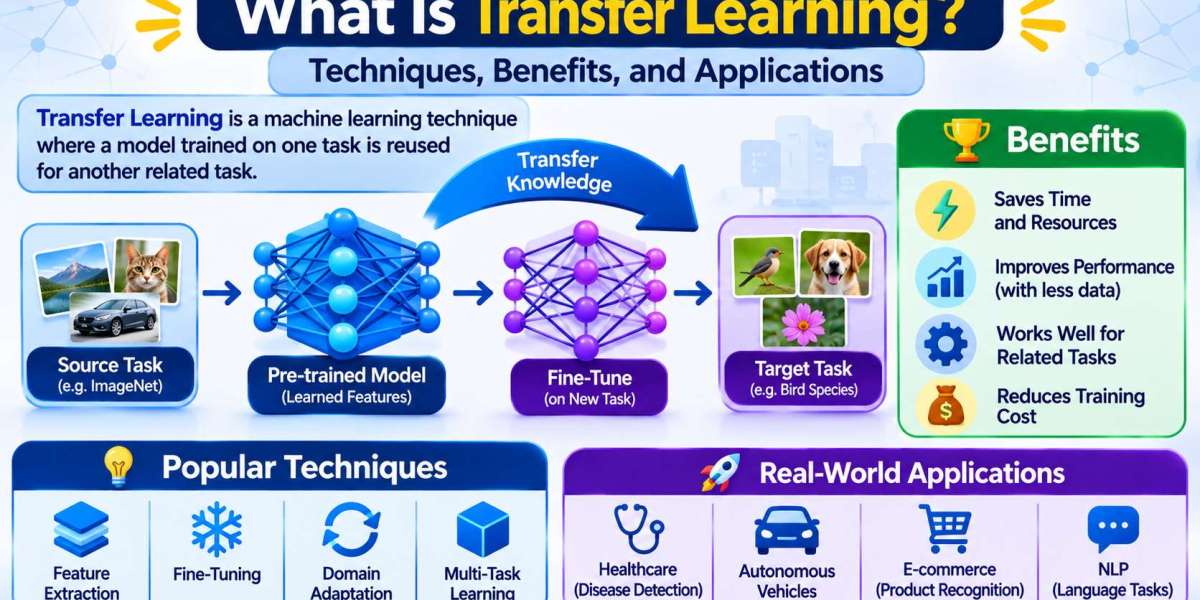

The training process for a machine learning model requires massive amounts of data, time, and computing power. Every team does not have these resources to develop the models in-house. Transfer learning provides an intelligent approach in such scenarios. Transfer learning involves leveraging the information acquired by the model for use on a different task altogether. If you wish to learn about transfer learning, then Machine Learning Classes in Bangalore is the perfect place to begin. This blog talks about transfer learning, its functioning, and applications.
What Is Transfer Learning?
Transfer learning refers to using a pre-trained machine learning model on another similar but distinct task. Imagine an individual who is familiar with riding a bicycle. They will find it easier to learn how to ride a motorcycle since they possess some commonalities. Similarly, when a computer learns to identify shapes, it can easily learn to detect objects.
Common Transfer Learning Techniques
Feature extraction involves retaining the pre-trained model unchanged but using it to extract important features from your dataset. In this case, you need to train only a few extra layers.
In Fine-Tuning, you load the pre-trained model and retrain some or even all layers on your own datasets. It results in improved performance compared to other transfer learning techniques.
Domain adaptation refers to training a model to work effectively with data that differs significantly from the one used during initial training.
Pretrained models involve starting from already existing models such as ResNet, VGG, BERT, and GPT-based models and adapting them according to your requirements.
Key Benefits of Transfer Learning
Needs less data: You can get good results even with a small dataset.
Saves time: Training is much faster than starting from zero.
Lowers cost: You need less computing power.
Better accuracy: Pre-trained knowledge often improves results.
Easy for beginners: You can build strong models without deep expertise.
Real-World Applications
Healthcare: Detecting diseases in X-rays and scans with limited medical data.
Image recognition: Identifying products, faces, and objects.
Language tasks: Chatbots, translation, and sentiment analysis.
Speech recognition: Adapting voice systems to new accents and languages.
Cybersecurity: Spotting new threats using knowledge from older attack patterns.
Conclusion
The technique of Transfer Learning will help organizations build robust models within limited data resources at affordable costs. Transfer Learning is one of the top skills required by someone starting off in Machine Learning.
At Digicrome, you will get industry-based programs for Data Science, AI, and Machine Learning. For those interested in training with hands-on projects in this field, taking Machine Learning Training in Hyderabad is indeed an intelligent choice. Start learning right away.