
INTRODUCTION
Embryo transfer is an important stage of assisted reproductive treatment that requires careful coordination between embryologists, fertility specialists, and supporting clinical staff. Professional IVF Labs Design plays a significant role in creating organized laboratory environments that support efficient embryo transfer preparation, reliable equipment performance, and controlled handling conditions. The preparation process involves embryo identification, culture assessment, documentation, preparation of transfer materials, and communication with the clinical team. Poor laboratory layouts, unnecessary sample movement, inadequate equipment positioning, and inconsistent environmental conditions can complicate these activities. By integrating suitable workstations, controlled ventilation, reliable electrical infrastructure, and efficient laboratory workflows, fertility clinics can improve operational consistency while maintaining appropriate safety and quality standards.
Understanding Embryo Transfer Preparation
Embryo transfer preparation involves several coordinated activities before the selected embryo is transferred into the patient's uterus.
These activities may include:
- Reviewing patient and embryo records
- Confirming embryo identification
- Assessing embryo readiness
- Preparing the transfer workstation
- Coordinating with the clinical team
- Preparing appropriate transfer equipment
- Completing required documentation
The exact sequence depends on the treatment protocol and whether fresh or previously cryopreserved embryos are being used.
Laboratory design should support these procedures without introducing unnecessary delays or handling complexity.
1. Creating an Efficient Laboratory Layout
An organized laboratory layout is fundamental to efficient embryo transfer preparation.
Professional IVF Labs Design should consider the relationship between embryo culture areas, preparation workstations, storage facilities, and the embryo transfer room.
Important planning considerations include:
- Logical equipment positioning
- Clear circulation routes
- Accessible workstations
- Organized storage
- Suitable maintenance clearances
- Defined sample movement pathways
A well-planned layout reduces unnecessary movement and helps laboratory personnel follow established procedures.
However, convenience should not compromise contamination-control requirements.
2. Minimizing Embryo Transport Distance
Embryos may need to be moved between incubators, preparation workstations, and the clinical transfer area.
Laboratory planning should minimize unnecessary movement while maintaining appropriate environmental conditions.
Potential benefits include:
- More efficient staff coordination
- Reduced handling complexity
- Better workflow organization
- Easier communication
- Fewer avoidable interruptions
Transport arrangements should follow approved embryology protocols.
Shorter distances can support efficiency, but proper handling procedures remain essential regardless of distance.
3. Positioning the Embryology Laboratory Near the Transfer Room
Where building constraints permit, placing the embryology laboratory close to the embryo transfer room can simplify coordination.
An effective arrangement may provide:
- A designated transfer route
- Controlled access
- Appropriate communication systems
- Convenient staff movement
- Suitable equipment positioning
Professional IVF Labs Design should evaluate adjacency during the initial architectural planning stage.
The final layout must also consider patient privacy, clinical access, and infection-prevention requirements.
4. Maintaining Stable Environmental Conditions
Embryo-handling procedures require suitable environmental conditions.
Laboratory infrastructure should support:
- Stable room temperature
- Appropriate humidity
- Controlled ventilation
- Suitable air quality
- Reliable equipment operation
Room conditions should be established according to equipment specifications and laboratory procedures.
Environmental stability supports consistent working conditions but cannot replace direct temperature control provided by specialized embryo-handling equipment.
5. Integrating Advanced HVAC Systems
HVAC engineering contributes to reliable laboratory operations.
An effective system should address:
- Ventilation requirements
- Temperature control
- Humidity management
- Airflow distribution
- Filtration
- Equipment heat loads
HVAC equipment should be designed to operate consistently during laboratory activities.
Regular maintenance and performance verification help identify developing problems.
Ventilation design should reflect the laboratory's contamination-control strategy.
6. Improving Air Quality Management
Airborne contaminants may affect the suitability of embryology environments.
Potential concerns include particles and certain chemical emissions.
Appropriate controls may include:
- High-efficiency particle filtration
- Suitable ventilation
- Low-emission construction materials
- Compatible cleaning products
- Chemical source control
- Environmental monitoring
HEPA filtration reduces airborne particles but does not independently remove volatile organic compounds.
Where chemical contaminants are a concern, additional measures may be necessary.
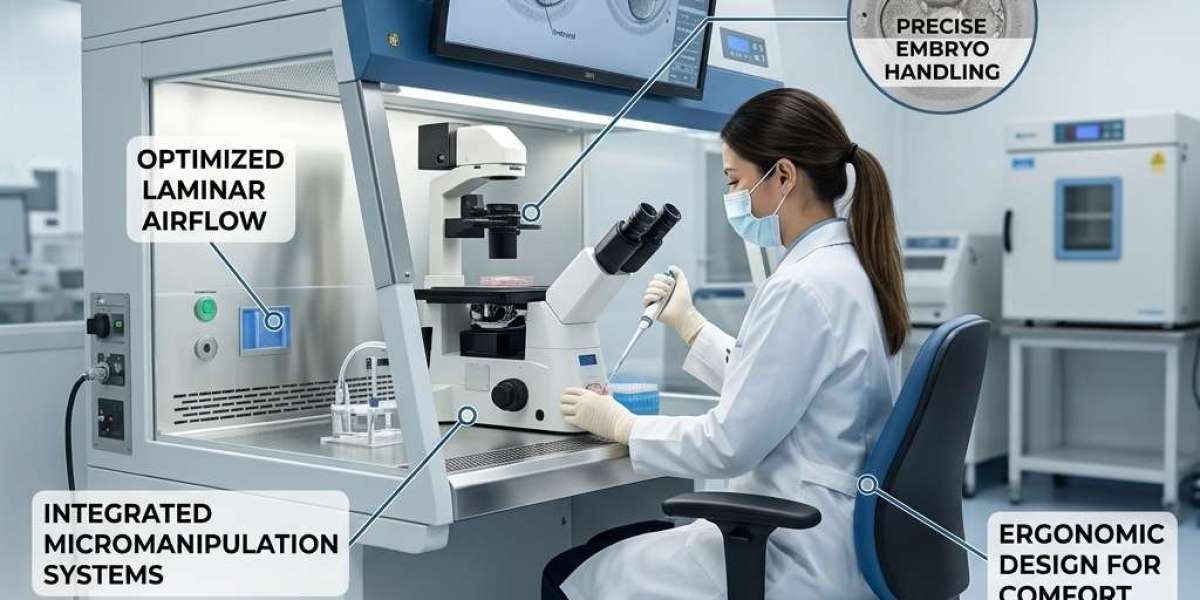
7. Providing Temperature-Controlled Workstations
Embryology workstations are essential for preparing embryos under controlled conditions.
Important workstation features may include:
- Heated work surfaces
- Suitable microscopy
- Appropriate illumination
- Equipment monitoring
- Ergonomic positioning
- Accessible supplies
Professional IVF Labs Design should coordinate workstation placement with electrical and equipment requirements.
Temperature settings must follow approved laboratory procedures.
Workstation performance should be verified before routine clinical use.
8. Supporting Reliable Incubator Access
Incubators provide controlled environments for embryo culture.
Efficient laboratory planning should allow staff to access incubators without unnecessary obstruction.
Important considerations include:
- Suitable equipment spacing
- Clear access routes
- Reliable electrical connections
- Gas supply compatibility
- Maintenance clearance
- Monitoring arrangements
Incubator placement should follow manufacturer recommendations.
Equipment should be positioned to minimize avoidable disturbances during routine laboratory work.
9. Organizing Embryo Transfer Equipment
Efficient preparation depends on convenient access to approved supplies and equipment.
Depending on laboratory protocols, relevant items may include:
- Transfer catheters
- Culture media
- Sterile consumables
- Identification materials
- Temperature-controlled equipment
- Documentation systems
Storage should support appropriate stock rotation and traceability.
Consumables must be stored according to manufacturer instructions.
Workstation organization should reduce unnecessary searching and handling.
10. Strengthening Sample Identification and Traceability
Accurate identification is essential during embryo transfer preparation.
Laboratory infrastructure should support:
- Unique patient identification
- Embryo record verification
- Appropriate witnessing procedures
- Barcode systems where used
- Electronic identification technologies
- Secure documentation
Digital systems can support traceability, but they do not replace approved witnessing protocols.
Patient and embryo identification must be verified according to the laboratory's quality-management procedures.
11. Supporting Digital Laboratory Management
Digital laboratory systems can improve coordination between embryologists and clinical personnel.
Potential functions include:
- Patient record access
- Embryo culture documentation
- Procedure scheduling
- Equipment records
- Transfer preparation checklists
- Authorized data sharing
Professional IVF Labs Design can incorporate suitable network infrastructure and workstation locations.
Digital systems should include appropriate access controls, data protection, and backup arrangements.
12. Improving Communication Between Teams
Embryo transfer preparation requires coordination between laboratory and clinical staff.
Poor communication can lead to delays or procedural confusion.
Facility planning may support communication through:
- Designated communication points
- Secure digital systems
- Clear staff responsibilities
- Coordinated scheduling
- Appropriate workflow procedures
Communication arrangements should protect patient confidentiality.
Efficient coordination depends on both infrastructure and trained personnel.
13. Supporting Fresh and Frozen Embryo Transfer Workflows
Fresh and frozen embryo transfer procedures have different preparation requirements.
Frozen embryo transfer involves additional cryopreservation-related processes.
Laboratory planning should consider:
- Access to cryogenic storage
- Designated warming workstations
- Suitable equipment
- Sample identification
- Controlled transfer routes
- Appropriate documentation
The exact procedures should follow validated laboratory protocols.
Facilities should provide suitable infrastructure for the treatments they offer.
14. Improving Cryopreservation Area Organization
Cryogenic storage areas require specialized safety measures.
Important considerations include:
- Appropriate liquid nitrogen storage
- Oxygen-deficiency monitoring
- Suitable ventilation
- Safe access routes
- Organized specimen inventory
- Emergency procedures
Liquid nitrogen can displace oxygen in enclosed spaces.
Cryopreservation areas should undergo a specific safety assessment.
Safe specimen retrieval requires trained personnel and accurate records.
15. Ensuring Reliable Electrical Infrastructure
Embryo transfer preparation depends on electrically powered equipment.
Important infrastructure elements include:
- Dedicated circuits
- Appropriate electrical protection
- Reliable equipment connections
- Emergency power provisions
- Safe cable management
- Electrical maintenance access
Power interruptions may disrupt workstation heating, microscopy, and monitoring systems.
Electrical systems should be designed according to equipment specifications and applicable safety requirements.
16. Integrating Automated Monitoring Systems
Automated monitoring can help laboratory personnel identify equipment and environmental deviations.
Depending on the facility, monitoring may include:
- Room temperature
- Humidity
- Incubator alarms
- Workstation temperature
- Electrical supply status
- Cryogenic storage conditions
Monitoring systems should use calibrated sensors and appropriate alarm settings.
Automation supports operational oversight but does not replace routine inspections.
17. Improving Ergonomic Workstation Design
Embryologists frequently perform detailed procedures requiring concentration and precision.
Ergonomic planning should consider:
- Workstation height
- Microscope positioning
- Adjustable seating
- Suitable lighting
- Comfortable working reach
- Equipment accessibility
An ergonomic environment can reduce unnecessary physical strain.
Workstation arrangements should reflect actual laboratory procedures and staff requirements.
18. Supporting Cleaning and Contamination Control
Cleanable surfaces and organized equipment arrangements support laboratory hygiene.
Suitable design features include:
- Smooth work surfaces
- Accessible joints
- Durable flooring
- Appropriate storage
- Compatible cleaning materials
- Minimal unnecessary clutter
Cleaning procedures should follow laboratory protocols.
Disinfectants and construction materials should be evaluated for compatibility with sensitive embryology environments.
19. Supporting Quality Assurance and Documentation
Embryo transfer preparation requires accurate records and standardized procedures.
Quality-management activities may include:
- Equipment calibration
- Environmental monitoring
- Procedure documentation
- Sample witnessing
- Maintenance records
- Deviation reporting
- Staff competency assessments
Professional IVF Labs Design should provide infrastructure that supports these activities.
Documentation helps maintain traceability and enables review of operational performance.
20. Meeting Regulatory Requirements in India
Fertility laboratories in India should consider the Assisted Reproductive Technology (Regulation) Act, 2021, applicable rules, and relevant professional guidance.
Important considerations include:
- Patient and specimen identification
- Laboratory equipment maintenance
- Quality-control procedures
- Documentation
- Staff training
- Safe facility infrastructure
The specific requirements depend on the services provided.
Facility design should support compliance, while operational procedures must be maintained by qualified personnel.
Conclusion
Efficient embryo transfer preparation depends on organized laboratory layouts, suitable environmental conditions, reliable equipment, accurate specimen identification, and effective communication between embryology and clinical teams. Professional IVF Labs Design can improve operational efficiency by coordinating workstation placement, incubator access, HVAC systems, electrical infrastructure, cryopreservation facilities, and digital laboratory management. Reducing unnecessary sample movement and maintaining accessible equipment arrangements can simplify daily procedures. However, successful embryo transfer preparation also requires validated protocols, trained personnel, and consistent quality assurance. Altus Airflow provides specialized fertility laboratory engineering solutions focused on controlled environments, modular infrastructure, equipment integration, and efficient embryology workflows.
Frequently Asked Questions (FAQs)
1. How does IVF Labs Design improve embryo transfer preparation?
IVF Labs Design improves embryo transfer preparation through organized workstations, efficient laboratory layouts, reliable utilities, and coordinated sample-handling routes.
2. Why is laboratory layout important in IVF Labs Design?
Laboratory layout is important in IVF Labs Design because it influences staff movement, equipment accessibility, sample handling, and workflow efficiency.
3. How does IVF Labs Design support temperature control?
IVF Labs Design supports temperature control through appropriate HVAC infrastructure, temperature-controlled workstations, equipment monitoring, and reliable electrical connections.
4. Can IVF Labs Design reduce unnecessary embryo movement?
Yes. IVF Labs Design can reduce unnecessary movement by positioning preparation workstations, incubators, and transfer facilities according to the approved workflow.
5. Why is HVAC important for embryo transfer preparation?
HVAC in IVF Labs Design supports suitable room temperature, humidity, ventilation, and airborne contamination-control conditions.
Read Our Previous Blog------>What are the essential requirements for an embryology workstation in Modular Ophthalmic OT Engineering Company?