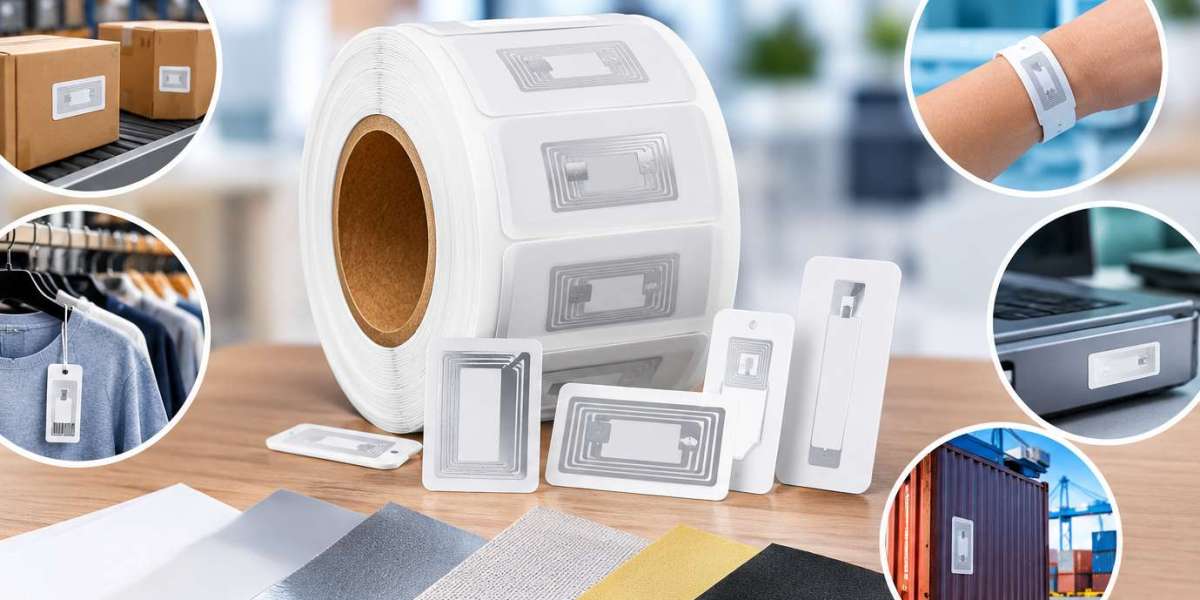

Choosing the right material for printable RFID labels is important for businesses that depend on accurate product identification, inventory tracking, and asset management. The material affects label durability, print quality, adhesive performance, and suitability for different working environments.
Whether a business operates in retail, manufacturing, warehousing, or logistics, selecting the right RFID label material can improve identification and tracking processes. Companies planning to buy printable rfid tags and labels kuwait should consider where the labels will be applied and what conditions they will face. It is also important to ensure that the labels work with the selected RFID printer and uhf rfid reader and antenna buy kuwait equipment.
This guide explains common materials used for printable RFID labels and how businesses can choose the right option for different applications.
Table of Contents
What Are Printable RFID Labels?
Why Does Label Material Matter?
Paper RFID Labels
Polyester RFID Labels
Polypropylene RFID Labels
Polyethylene RFID Labels
RFID Labels for Special Applications
How to Choose the Right RFID Label Material
Frequently Asked Questions
Conclusion and Call to Action
1. What Are Printable RFID Labels?
Printable RFID labels combine a printed label surface with an embedded RFID inlay. The inlay contains a microchip and antenna that allow compatible RFID readers to identify the tagged item using radio signals.
Businesses can print information such as product names, barcodes, serial numbers, and other details while using the RFID technology for electronic identification.
These labels are commonly used in warehouses, retail stores, manufacturing facilities, healthcare environments, and supply chains.
2. Why Does Label Material Matter?
The label material determines how well it performs in its intended environment. A material suitable for indoor retail products may not withstand moisture, friction, or outdoor exposure.
Important considerations include:
Durability: How well the label resists tearing, scratching, and wear.
Print quality: Whether text, barcodes, and other information remain clear.
Moisture resistance: Whether the label can tolerate humidity or occasional contact with water.
Temperature tolerance: Whether it can handle the application's operating conditions.
Adhesion: Whether it stays attached to cardboard, plastic, glass, or other surfaces.
RFID performance: Whether the label's construction and placement allow reliable communication with RFID readers.
3. Paper RFID Labels
<AsyncImage query="white paper RFID label rolls printable barcode labels close up" aspectRatio="16:9" width="100%"/>
Paper is a common and economical material for RFID labels used in indoor applications. It supports clear printing and is suitable for many everyday identification requirements.
Best applications:
Retail product labeling
Warehouse inventory
Carton and packaging identification
Library item tracking
Short-term logistics operations
Paper RFID labels are generally appropriate for dry environments where heavy wear is not expected. However, standard paper labels may be vulnerable to moisture, tearing, and abrasion. A protective coating can improve surface resistance, depending on the label construction.
4. Polyester RFID Labels
<AsyncImage query="white polyester synthetic RFID industrial labels on roll" aspectRatio="16:9" width="100%"/>
Polyester is a durable synthetic material often selected for applications that require better resistance to moisture, chemicals, and physical wear than ordinary paper labels.
Best applications:
Industrial equipment identification
Electronic components
Asset tracking
Manufacturing environments
Long-term product identification
Polyester labels can provide good print durability when paired with a compatible printing method and ribbon. Businesses should check the specific material's temperature and chemical resistance before purchasing.
5. Polypropylene RFID Labels
<AsyncImage query="white polypropylene synthetic product labels on roll" aspectRatio="16:9" width="100%"/>
Polypropylene is a lightweight synthetic material that offers moisture resistance and flexibility. It is often used when businesses need a label that looks clean and performs better than standard paper in humid conditions.
Best applications:
Consumer product packaging
Retail inventory
Cosmetic packaging
Food packaging identification
General warehouse labeling
Polypropylene labels can be useful for products exposed to occasional moisture. However, their performance depends on the adhesive, coating, and surrounding conditions.
6. Polyethylene RFID Labels
<AsyncImage query="flexible polyethylene plastic labels roll product packaging" aspectRatio="16:9" width="100%"/>
Polyethylene is a flexible material that can work well on curved or squeezable surfaces. Its flexibility makes it suitable for certain packaging applications where a stiffer label may not adhere smoothly.
Best applications:
Flexible plastic containers
Bottles and curved packaging
Squeezable product packaging
Selected chemical containers
Because polyethylene has relatively low surface energy, choosing a compatible adhesive is especially important. Businesses should also confirm that the RFID inlay is suitable for the intended surface.
7. RFID Labels for Special Applications
Some environments require more specialized label constructions.
On-metal RFID labels: Designed with special structures or spacers to work on metal surfaces, which can interfere with ordinary RFID tags.
High-temperature labels: Selected for applications involving elevated temperatures, subject to the material's rated limits.
Tamper-evident RFID labels: Designed to show evidence of removal or interference.
Outdoor RFID labels: Built with suitable materials, adhesives, and protective surfaces for weather exposure.
These options should be selected according to the actual operating conditions rather than appearance alone.
8. How to Choose the Right RFID Label Material
Before purchasing, businesses should evaluate the following factors:
Identify the surface: Determine whether the label will be applied to cardboard, plastic, glass, metal, or another material.
Understand the environment: Check exposure to moisture, heat, sunlight, chemicals, and friction.
Select the printing method: Confirm whether the label supports the intended thermal transfer or other compatible printing process.
Check RFID compatibility: Verify the inlay's frequency, chip, and compatibility with the RFID reader.
Choose the right adhesive: Make sure it suits the surface and expected application conditions.
Test before bulk purchasing: Evaluate print quality, attachment, and RFID reading performance using actual products.
Businesses planning to buy printable rfid tags and labels kuwait should also confirm printer compatibility, label size, inlay positioning, and encoding requirements. If the labels will be used with a uhf rfid reader and antenna buy kuwait solution, test them with the actual reader and antenna setup.
9. Frequently Asked Questions
Q1. Which material is best for printable RFID labels?
Paper is suitable for many indoor applications, while polyester and polypropylene are often better choices when additional durability or moisture resistance is needed. The best option depends on the environment.
Q2. Are paper RFID labels waterproof?
Standard paper RFID labels are generally not waterproof. Special coatings may provide some protection, but synthetic materials are usually more suitable for moisture-prone applications.
Q3. Can RFID labels be printed using thermal transfer printers?
Some printable RFID labels are designed for thermal transfer printing. Businesses must confirm that the label construction, printer, and ribbon are compatible.
Q4. Can ordinary RFID labels be used on metal surfaces?
Not always. Metal can interfere with UHF RFID communication. Special on-metal RFID labels are generally recommended for these applications.
Q5. Does label material affect RFID reading performance?
It can. The label construction, inlay design, attachment surface, and tag placement may influence performance. Testing is recommended before large-scale deployment.
Conclusion and Call to Action
The best material for printable RFID labels depends on the application, environment, surface type, printing method, and required durability. Paper, polyester, polypropylene, and polyethylene each offer different benefits, while specialized labels are available for challenging environments such as metal surfaces and outdoor use.
For businesses evaluating RFID labeling solutions, Pointus Solutions can be a starting point for exploring printing products and identifying suitable options. Compare label materials, confirm printer and reader compatibility, and test samples before making a bulk purchase to support reliable identification and tracking.