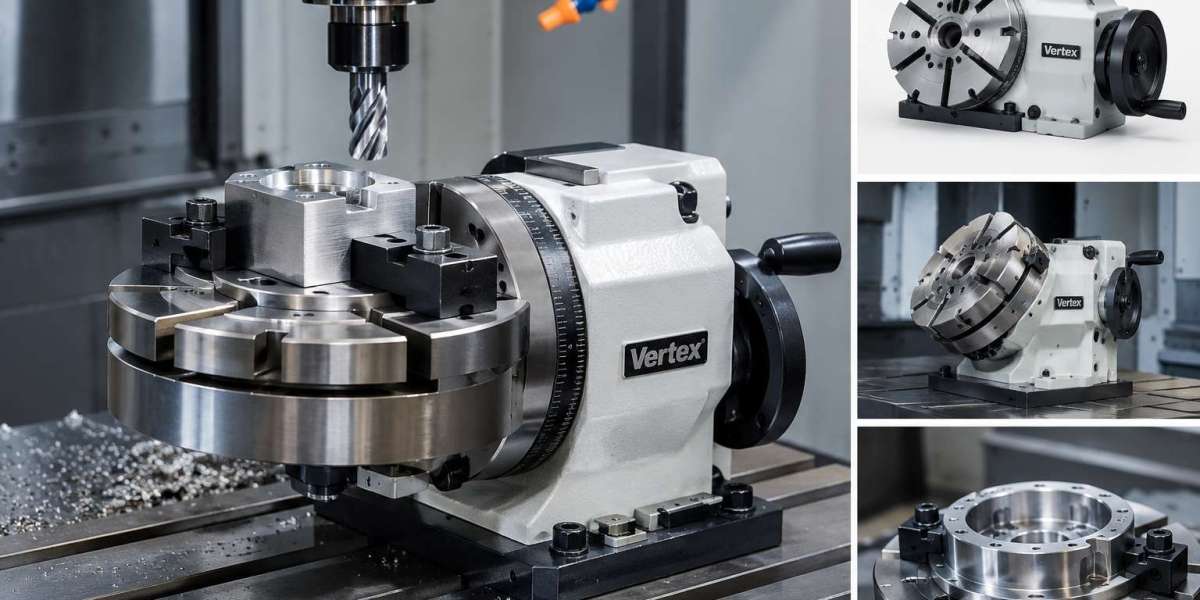

A rotary table is an important workholding accessory used in milling operations that require accurate circular movement, angular positioning, and indexing. It allows operators to machine components at different angles and produce features such as slots, holes, arcs, and circular patterns with greater control.
Choosing the right rotary table depends on your milling machine, workpiece dimensions, machining requirements, and desired accuracy. Whether you operate a small workshop or a large manufacturing facility, selecting a suitable model can improve productivity and machining consistency. Khokhawala Trading LLC helps industrial buyers explore machining accessories and equipment, including options for those searching for a vertex rotary table for sale UAE.
Table of Contents
What Is a Rotary Table?
Types of Rotary Tables
Important Factors When Choosing a Vertex Rotary Table
Common Milling Applications
Buying Mistakes to Avoid
FAQs
Conclusion and CTA
1. What Is a Rotary Table?
A rotary table is a precision workholding device that rotates a workpiece around a fixed axis. It is commonly installed on milling machines to support operations that require controlled angular movement.
Rotary tables are useful for machining circular components, cutting arcs, drilling holes at equal intervals, and producing angled features. Depending on the model, they can be operated manually or integrated with suitable machine systems.
2. Types of Rotary Tables
Understanding the available configurations helps you select the right equipment.
Horizontal Rotary Table
A horizontal rotary table is mounted flat on the milling machine bed. It is suitable for circular milling, drilling, slotting, and indexing operations where the workpiece rotates around a vertical axis.
Vertical Rotary Table
A vertical rotary table is positioned upright, allowing operators to machine workpieces from different angles. It is useful for applications involving cylindrical components and angular features.
Tilting Rotary Table
A tilting model allows adjustment between different working angles. It offers flexibility when machining complex components that require both rotational and angular positioning.
3. Important Factors When Choosing a Vertex Rotary Table
Before selecting a rotary table, evaluate these essential specifications.
Table Diameter
The table diameter determines the size of workpieces that can be accommodated. Choose a diameter suitable for your regular components while allowing enough space for clamps and fixtures.
Load Capacity
Check the maximum weight the rotary table can safely support. Consider both the workpiece weight and the weight of additional fixtures or clamping accessories.
Indexing Accuracy
Accuracy is important when producing equally spaced holes, slots, and circular features. Review the manufacturer's specifications for indexing precision and repeatability.
Gear Ratio and Handwheel Movement
The gear ratio affects how much the table rotates with each handwheel movement. Select a configuration that provides the control required for your machining tasks.
Mounting Compatibility
Confirm that the rotary table can be mounted securely on your milling machine. Check its base dimensions, mounting slots, and available clamping arrangements.
Construction and Durability
A robust construction helps maintain stability under machining loads. Inspect the table, locking mechanism, gears, and operating components before purchasing.
4. Common Milling Applications
A Vertex rotary table can support several machining operations, depending on its configuration and specifications.
Circular milling: Produces curved surfaces, arcs, and circular profiles.
Drilling bolt-hole patterns: Helps position holes at equal angular intervals.
Gear-related machining: Supports indexing operations for suitable gear-cutting applications.
Angular machining: Positions workpieces for machining at selected angles.
Slotting: Helps create accurately spaced slots around a component.
Selecting the right rotary table makes these operations easier to set up and control.
5. Buying Mistakes to Avoid
Avoid these common mistakes when purchasing a rotary table:
Choosing a table without checking its diameter and load capacity.
Ignoring milling machine mounting compatibility.
Overlooking indexing accuracy and gear specifications.
Selecting a model that does not suit the required machining angles.
Focusing only on price instead of construction and performance.
Forgetting to consider clamps and other workholding accessories.
Compare the technical specifications with your actual workshop requirements before placing an order.
6. FAQs
1. What is a rotary table used for in milling?
It rotates and positions workpieces for circular milling, angular machining, drilling patterns, and indexing operations.
2. How do I choose the correct rotary table size?
Consider your workpiece dimensions, fixture space, machine capacity, and the available mounting area.
3. What is the difference between horizontal and vertical rotary tables?
A horizontal table is mounted flat, while a vertical table is positioned upright to support different machining orientations.
4. Why is indexing accuracy important?
It helps position workpieces at precise angular intervals, improving the consistency of holes, slots, and other machined features.
5. What should I check before buying a Vertex rotary table?
Check table diameter, load capacity, indexing specifications, mounting compatibility, construction, and available accessories.
6. Where can I find a Vertex rotary table for sale in the UAE?
Contact Khokhawala Trading LLC to discuss your milling requirements and check suitable rotary table options.
7. Conclusion and CTA
Choosing the right Vertex rotary table requires careful consideration of table size, load capacity, indexing accuracy, mounting compatibility, and machining applications. A suitable model can improve workpiece positioning, support accurate indexing, and make complex milling operations more manageable.
For guidance on industrial machining accessories and equipment, contact Khokhawala Trading LLC. Whether you are looking for a vertex rotary table for sale UAE or planning to buy drill chuck and arbor Dubai, selecting compatible, application-specific products can help your workshop achieve reliable results.






