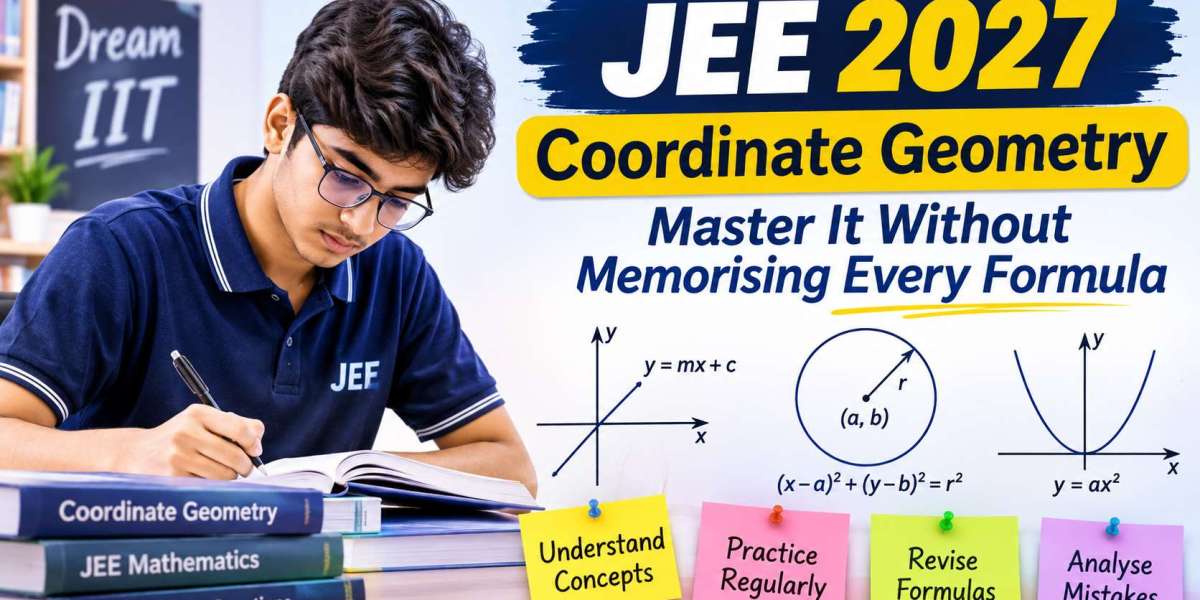

Coordinate Geometry is an important part of JEE Mathematics, but many students find it difficult because questions involve multiple formulas, diagrams, and geometric relationships. Memorising equations alone is not enough when a problem requires you to identify the right approach.
For JEE 2027, students should focus on understanding the geometry behind equations, recognising patterns, and practising different question types. A structured approach can make Coordinate Geometry easier to understand and revise.
1. Build a Strong Foundation in Straight Lines
Straight Lines form the foundation of several Coordinate Geometry concepts. Start by understanding slope, intercepts, and different forms of the equation of a line.
Focus on:
Slope and angle between two lines
Point-slope and intercept forms
General equation of a straight line
Distance of a point from a line
Conditions for parallel and perpendicular lines
Practise converting one equation form into another. This helps you recognise which formula is most useful for a particular question.
2. Understand Circles Through Their Geometric Properties
Instead of memorising every circle formula separately, understand how the centre and radius determine its equation.
Study the standard and general forms of a circle. Practise finding the centre and radius by completing the square.
Pay special attention to:
Equation of a circle
Position of a point relative to a circle
Tangents and normals
Chord properties
Conditions for tangency
Drawing a rough diagram before solving a question can help you visualise the given information.
3. Learn Conic Sections Step by Step
Parabola, ellipse, and hyperbola require careful understanding of their standard equations and geometric properties.
For each conic, revise:
Standard equations
Focus and directrix
Eccentricity
Length of latus rectum
Tangent and normal equations
Create a comparison sheet for the three conic sections. This will help you remember their differences and avoid mixing up formulas during revision.
4. Focus on Tangents and Normals
Questions involving tangents and normals often require students to combine equations with geometric reasoning.
Understand the meaning of a tangent and how its slope relates to the curve at a particular point. Practise standard results, but also learn how they are derived.
Start with direct questions and gradually move to problems involving multiple conditions, such as finding a tangent passing through a given point.
5. Practise Questions Topic by Topic
Solving random questions without mastering individual concepts can create confusion.
Follow a gradual practice sequence:
Solve basic questions after studying each concept.
Move to moderate JEE Main-level problems.
Practise previous-year questions.
Attempt mixed questions involving two or more concepts.
Review difficult questions and identify alternative methods.
This approach improves both conceptual clarity and problem-solving flexibility.
6. Improve Accuracy Through Regular Revision
Coordinate Geometry involves several formulas and conditions, so regular revision is essential.
Maintain a short notebook containing important equations, standard results, and common mistakes. Review it frequently, especially before mock tests.
After every test, identify whether your mistakes occurred because of incorrect formula selection, diagram interpretation, algebraic calculations, or time pressure.
Practise timed question sets once your concepts are clear. Focus on accuracy first and gradually improve your speed.
Conclusion
Mastering Coordinate Geometry for JEE 2027 requires a balance of conceptual understanding, formula revision, and consistent problem-solving practice. Students should understand the geometric meaning of equations instead of relying entirely on memorisation.
With regular practice and careful analysis of mistakes, you can improve your confidence in Straight Lines, Circles, and Conic Sections. Students seeking structured preparation can also explore IIT JEE coaching in Alwar for academic guidance and support.