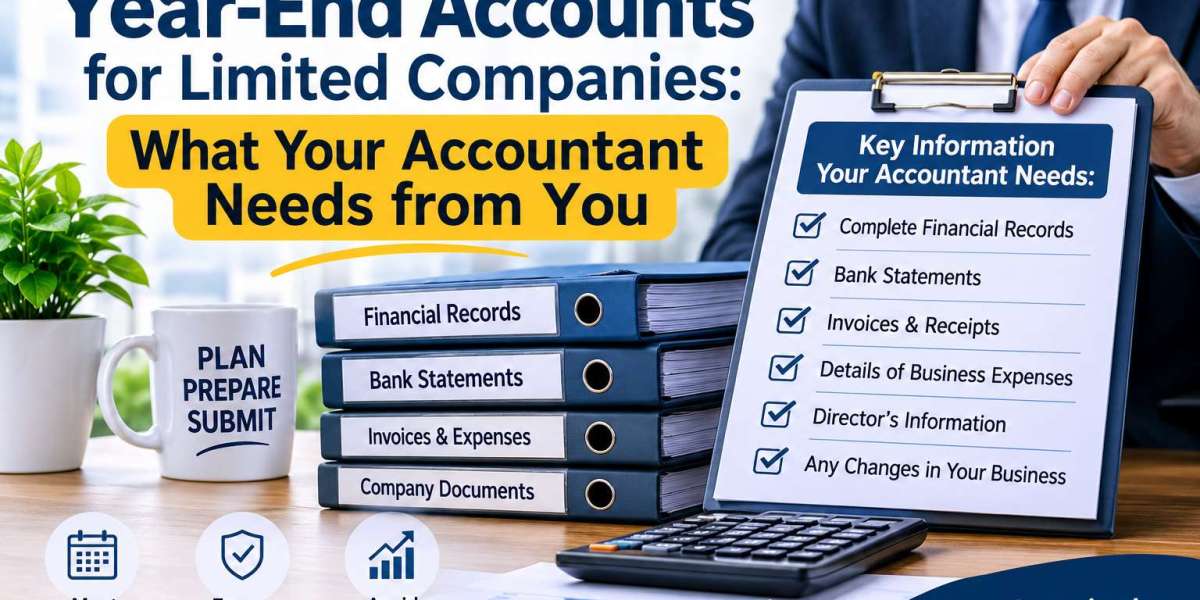

Year-end accounts for limited companies do not have to mean a last-minute scramble for receipts. The quality and speed of your accounts depend largely on the information you give your accountant, and most delays come from missing or disorganised records.
This guide explains what year-end accounts are, exactly what your accountant needs from you and how to make the process quicker, cheaper and more accurate.
What Are Year-End Accounts for a Limited Company?
Year-end accounts, also called statutory or annual accounts, summarise your company’s financial performance and position at the end of its financial year. They usually include a balance sheet, a profit and loss account and supporting notes.
Every limited company must prepare annual accounts, whether it is trading or not. They are filed with Companies House and sent to HMRC with your Corporation Tax return. What is filed publicly at Companies House depends on the size of your company, and these requirements are changing, so check current guidance or ask your accountant.
Year-end accounts and your Corporation Tax return are separate documents. The accounts show what the company earned and owns. The tax return uses those figures to calculate how much Corporation Tax the company owes.
What Information Does Your Accountant Need to Prepare Year-End Accounts?
Business Bank Statements and Financial Records
Provide statements for every business account for the full financial year, including savings accounts, credit cards and payment platforms such as PayPal or Stripe. If you use Xero or similar software with bank feeds, your accountant may already have access.
Sales Invoices and Purchase Receipts
Your accountant needs a record of all sales invoices issued and all purchase invoices and receipts. Digital copies are fine, provided they are complete and legible.
Business Expenses and Outstanding Payments
Include details of business expenses, along with any bills you owed or were owed at the year end. For example, if your year end is 31 March and you completed a job in March but did not invoice it until April, your accountant may need to include that income in the year to March.
Bank Reconciliation and Cash Transactions
Every transaction in your bank account should be matched to an invoice, receipt or explanation. List any cash payments or receipts that did not go through the bank, as these are easily missed.
Payroll and PAYE Records
Provide payroll summaries, PAYE and National Insurance payments, pension contributions and details of any benefits provided to staff or directors.
VAT Returns and Supporting Documents
If your company is VAT-registered, include copies of the VAT returns submitted during the year and the records behind them. Your accountant will check that the VAT figures agree with the accounts.
Fixed Assets and Equipment Purchases
List any equipment, vehicles, computers or machinery bought or sold during the year, with dates and costs. These affect your balance sheet and the capital allowances your company can claim. If you hold stock, provide a stock valuation at the year end too.
Director’s Loan Account Information
Record any money you took from or paid into the company that was not salary, dividends or a reimbursed expense. If a director’s loan account is overdrawn at the year end and not repaid within nine months, the company may face an additional tax charge, so your accountant needs accurate figures.
Existing Loans, Creditors and Debtors
Include statements for any business loans, finance agreements or overdrafts, plus lists of money owed to suppliers and money owed to you by customers at the year end.
Why Accurate Bookkeeping Makes Year-End Accounts Easier
When your records are kept up to date throughout the year, year-end accounts become a review rather than a rebuild.
Cloud accounting software such as Xero makes this easier. Bank feeds bring in transactions automatically, receipts can be photographed and attached, and your accountant can see the same live figures you do. Reconciling transactions monthly rather than annually means fewer queries, fewer errors and a faster turnaround.
If keeping on top of your books is a struggle, regular bookkeeping support can save time and usually reduces the work needed at year end.
Important Deadlines for Limited Company Accounts
Limited companies have three separate deadlines, and they are easy to confuse:
| What | Deadline |
|---|---|
| Annual accounts to Companies House | 9 months after your company’s financial year end |
| Corporation Tax payment | 9 months and 1 day after the end of the accounting period |
| Corporation Tax return (CT600) to HMRC | 12 months after the end of the accounting period |
Your first accounts have a different deadline: usually 21 months after the date your company was incorporated. Very large companies pay Corporation Tax in instalments, so different payment dates apply.
Note that tax must be paid before the Corporation Tax return is due. Preparing your accounts early tells you how much tax to set aside.
Common Mistakes to Avoid When Preparing Year-End Accounts
- Missing invoices and receipts: unsupported expenses may not be allowable, which can increase your tax bill.
- Incorrect expense categorisation: mixing personal and business costs, or posting items to the wrong category, distorts your figures.
- Unreconciled bank transactions: unexplained transactions lead to queries and delays.
- Incomplete payroll records: missing pension or PAYE details can cause mismatches with HMRC records.
- Missing director’s loan information: this can lead to unexpected tax charges.
- Leaving records until the last minute: a rush increases the risk of errors and missed deadlines.
How an Accountant Can Help Your Limited Company
A year-end accounts accountant does far more than file paperwork. Professional accounting services can cover:
- preparing and filing annual accounts with Companies House
- bookkeeping and regular financial reporting
- preparing your Corporation Tax return and calculations
- payroll accounting and PAYE compliance
- Xero setup, training and ongoing support
- tax planning, including advice on salary and dividends
With the accounts and tax return prepared together, you get a consistent set of figures and clear advice on what you owe and when.
Choosing the Right Accountancy Firm in Milton Keynes
When choosing an accountant in Milton Keynes, look for experience with limited companies of your size, membership of a recognised professional body and clear, fixed pricing. Good communication matters too, so you know what is needed from you and when.
If you use Xero, choose Xero accountants who can work directly in your software. A local accountancy firm also makes it easy to meet in person when you need to discuss your accounts or plans for the year ahead.
If you would like support with your year-end accounts, speak to our team about accounts preparation, bookkeeping, payroll and Corporation Tax.
Frequently Asked Questions
What documents does an accountant need for year-end accounts?
Bank statements, sales and purchase invoices, receipts, payroll records, VAT returns, details of assets bought or sold, loan statements, director’s loan account transactions and lists of amounts owed to and by the company at the year end.
When should I send my records to my accountant?
As soon as possible after your year end, ideally within a few months. Sending records early gives time to resolve queries and tells you how much Corporation Tax to set aside before the payment deadline.
How long does it take to prepare limited company accounts?
It depends on the size of the company and the state of its records. Well-organised records can often be turned around in a few weeks, while incomplete or unreconciled records take longer.
Do limited companies need to submit annual accounts to Companies House?
Yes. Every limited company must file annual accounts with Companies House, even if it has not traded. Dormant companies can usually file simpler dormant accounts, but they must still meet the filing deadline.
What happens if I miss my company accounts filing deadline?
Companies House issues an automatic late filing penalty, which increases the later the accounts are and doubles if they are late two years in a row. Persistent failure to file can lead to the company being struck off.
Are bookkeeping records required for year-end accounts?
Yes. Your accountant prepares the accounts from your bookkeeping records. Companies must also keep accounting records, generally for at least six years from the end of the financial year they relate to.
Can Xero help prepare year-end accounts?
Xero does not produce statutory accounts on its own, but it keeps your records organised and up to date. Your accountant can work directly from your Xero data, making year-end accounts faster and more accurate.
Can an accountant prepare both annual accounts and Corporation Tax returns?
Yes. Most accountants prepare both together, as the Corporation Tax return is based on the figures in your annual accounts. This keeps everything consistent and ensures both deadlines are met.