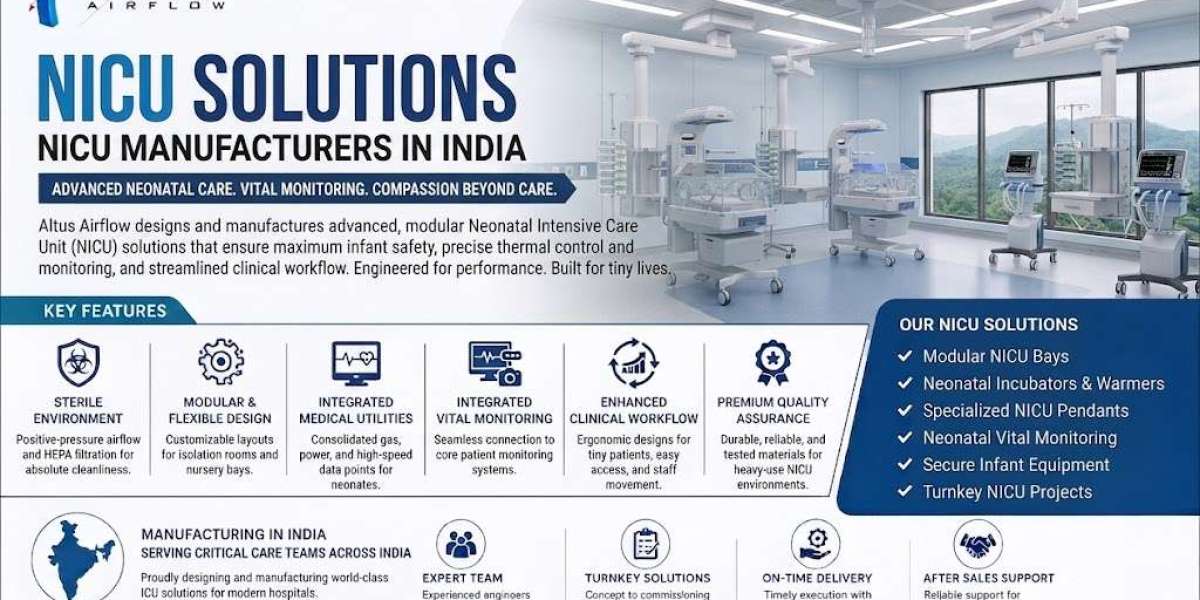

Introduction
A Neonatal Intensive Care Unit (NICU) is a specialised hospital environment designed to provide continuous care and medical support to newborns, including premature and critically ill infants. Developing such a facility requires careful planning of the physical layout, temperature regulation, ventilation, medical utilities, equipment placement, and infection prevention measures. Each infrastructure component should support the clinical team while maintaining an environment suitable for vulnerable newborns.
Hospitals looking for reliable NICU Manufacturers In India should evaluate technical expertise, previous healthcare projects, product quality, and the ability to coordinate different engineering systems. The right project partner should understand neonatal care requirements and work with hospital administrators, neonatologists, nursing teams, biomedical engineers, and technical consultants. A structured selection process can help hospitals develop a functional, organised, and maintainable neonatal care facility.
1. Start With the Hospital's Neonatal Care Requirements
Before approaching manufacturers, hospitals should define the purpose and expected capacity of the proposed NICU. Requirements may vary depending on the level of neonatal care, patient categories, available clinical services, and the hospital's overall maternity and newborn care facilities.
The project team should identify:
Planned number of neonatal care spaces.
Expected types of newborn cases.
Incubator, warmer, and monitoring requirements.
Medical gas and electrical provisions.
Temperature and ventilation requirements.
Handwashing and infection prevention facilities.
Staff workstations and supporting rooms.
Storage and equipment maintenance areas.
India's Facility Based Newborn Care Operational Guidelines provide infrastructure recommendations for newborn care units. Hospitals can use these guidelines as a reference while preparing the project brief and evaluating proposed designs.
2. Look for Experience in Specialised Healthcare Infrastructure
Experience in general construction does not automatically demonstrate expertise in neonatal care environments. A NICU requires specialised coordination between room finishes, environmental systems, medical utilities, equipment, and clinical workflows.
Hospitals should review a manufacturer's previous healthcare projects and ask for details about its role in each project. Relevant experience may include:
Neonatal and intensive care unit infrastructure.
Modular wall and ceiling installations.
Medical utility coordination.
HVAC and environmental control interfaces.
Equipment mounting and service access.
Installation supervision and project handover.
Ask for project references, technical documentation, and examples of completed work where possible. It is important to understand whether the company handled design, manufacturing, supply, installation, or only selected components of the project.
3. Evaluate NICU Layout Planning Capabilities
A properly planned NICU should allow staff to monitor newborns, access equipment, perform procedures, and respond to emergencies without unnecessary movement or obstruction.
The layout should consider incubator and cot positioning, bedside access, nursing visibility, staff circulation, storage, and supporting clinical spaces. It should also account for the movement of clean supplies, used materials, and equipment.
Hospitals should involve neonatologists and nursing representatives during design reviews. Their feedback helps ensure that the proposed arrangement reflects actual care practices instead of focusing only on room dimensions and appearance.
4. Check Temperature and Humidity Control Planning
Temperature management is particularly important in neonatal care because newborns, especially premature infants, can be sensitive to environmental changes. A NICU should have an environmental control plan suited to the clinical needs of the infants and the unit's operating requirements.
Hospitals should ask whether the manufacturer can coordinate with qualified HVAC professionals to plan temperature regulation, humidity, air circulation, and ventilation. The design should also consider differences between infant-care spaces and staff support areas.
India's 2025 Facility Based Newborn Care Operational Guidelines discuss temperature, humidity, ventilation, and the need to minimise direct draughts near newborn beds. These requirements should be assessed against the hospital's specific clinical and engineering needs.
5. Assess Medical Gas and Electrical Utility Integration
NICUs depend on essential medical utilities to support respiratory care, monitoring, and other clinical procedures. Depending on the unit's services and equipment, provisions may include oxygen, medical air, suction, electrical outlets, emergency power, and communication connections.
A capable manufacturer should coordinate the utility layout with the planned incubator, warmer, ventilator, and monitoring positions. Hospitals should verify that outlets are accessible to clinical teams and that cables and connections do not obstruct movement around infant-care spaces.
Electrical and medical gas systems should be designed, installed, inspected, and tested by qualified specialists. Hospitals should confirm the responsibilities for these activities before finalising the project scope.
6. Review Modular Wall and Ceiling System Quality
Modular wall and ceiling systems can help organise the internal environment of a neonatal care unit. They may provide planned interfaces for electrical points, lighting, medical utility connections, equipment supports, and access to concealed services.
Before selecting a manufacturer, hospitals should review:
Panel material and technical specifications.
Surface finish and cleanability.
Joint sealing and corner details.
Durability and maintenance requirements.
Access openings for concealed services.
Compatibility with HVAC and electrical systems.
Availability of replacement components.
Material choices should support routine cleaning and be suitable for the intended healthcare environment. The hospital should also review samples and technical documents rather than relying only on product descriptions.
7. Examine Infection Prevention and Hygiene Considerations
Infection prevention is a major consideration in neonatal care environments. Newborns may be vulnerable to infections, so the facility should support effective cleaning, appropriate ventilation, hand hygiene, and organised handling of clinical supplies.
Hospitals should assess whether the proposed design includes cleanable surfaces, properly finished joints, accessible handwashing points, and suitable arrangements for clean and used materials. Storage and waste-handling areas should also be planned so that routine operations do not create unnecessary cross-movement.
Manufacturers should coordinate these design considerations with the hospital's infection-control team. Their role is to provide suitable infrastructure and interfaces; the hospital's clinical policies and infection prevention procedures remain essential to safe operation.
8. Verify Neonatal Equipment Coordination Capabilities
A NICU may require incubators, radiant warmers, neonatal ventilators, patient monitors, infusion pumps, phototherapy units, and other specialised equipment. Each device has its own space, electrical, utility, and maintenance requirements.
The manufacturer should be able to coordinate with the hospital's biomedical engineering team and equipment suppliers. This may involve reviewing equipment dimensions, mounting arrangements, connection points, cable routes, and access for servicing.
A useful supporting consideration is neonatal bedside equipment and utility coordination. Planning equipment interfaces alongside the room layout can help keep infant-care spaces organised and reduce conflicts between medical devices and infrastructure.
Hospitals should prepare an equipment schedule early and share available technical specifications before the final drawings are approved. The selection and clinical suitability of medical devices should remain with the hospital's clinical and biomedical teams.
9. Consider Staff Workflow and Family Support Facilities
A NICU must support the daily activities of neonatologists, nurses, technicians, and other healthcare professionals. Staff should have convenient access to infant-care spaces, monitoring stations, clinical supplies, and supporting facilities.
The wider layout may include nursing stations, doctors' work areas, clean and dirty utility rooms, storage, handwashing facilities, and counselling spaces. Where appropriate, family waiting and communication areas should also be considered.
Hospitals should review how these spaces connect with the infant-care area while maintaining privacy, hygiene, and controlled access. A manufacturer that considers the complete unit rather than only the bedside panels can contribute to more practical infrastructure planning.
10. Evaluate HVAC and Airflow Coordination
Ventilation planning should support suitable environmental conditions while avoiding uncomfortable air movement near newborn beds. The system should be designed according to the unit's clinical purpose, relevant guidance, and the hospital's engineering assessment.
Hospitals should ask how the manufacturer coordinates with HVAC consultants on duct routes, air distribution, filtration provisions, temperature and humidity control, and maintenance access. Equipment locations and ceiling openings should be reviewed together to avoid conflicts during installation.
The Facility Based Newborn Care Operational Guidelines recommend ventilation arrangements that limit the movement of particulate matter and minimise draughts around newborn beds. The project team should translate these considerations into a site-specific HVAC design and verify the completed system through appropriate testing.
11. Check Project Management and Installation Standards
NICU projects often involve several specialist teams, including architects, civil contractors, HVAC engineers, electrical specialists, medical gas providers, biomedical engineers, and equipment suppliers. Coordination between these teams is essential to avoid installation conflicts and delays.
Hospitals should evaluate whether the manufacturer has a structured project management process covering:
Site measurements and readiness assessment.
Drawing preparation and approval.
Material manufacturing and delivery.
Installation planning and supervision.
Coordination with other contractors.
Quality inspections and progress updates.
Documentation of approved site changes.
The proposed schedule should be realistic and based on the agreed scope, site conditions, and availability of materials. Hospitals should also establish who is responsible for resolving issues that involve more than one contractor.
12. Confirm Testing, Commissioning, and Handover Support
After installation, the hospital should verify that the completed infrastructure matches approved drawings and project specifications. Testing and commissioning responsibilities should be assigned to qualified specialists for each relevant system.
Depending on the project scope, the handover package may include:
Approved layout and engineering drawings.
Material and product specifications.
Equipment and utility coordination schedules.
Installation and inspection records.
HVAC and environmental testing reports.
Electrical and medical gas test documents.
As-built drawings.
Operation and maintenance manuals.
Warranty and service information.
Hospitals should review these records and confirm that outstanding installation issues have been addressed. Clear documentation supports future maintenance and helps facility teams understand the systems installed in the unit.
13. Assess After-Sales Service and Long-Term Support
NICU infrastructure must be maintained to support continuous hospital operations. Hospitals should therefore assess the manufacturer's after-sales service before making a final decision.
Ask about warranty coverage, technical assistance, replacement components, maintenance instructions, and the procedure for reporting installation-related concerns. Clarify whether the company supports all supplied components or whether certain systems require separate service agreements.
Biomedical equipment maintenance should also be planned separately with the hospital's biomedical engineering team and equipment service providers. Government technical resources include specifications for neonatal and paediatric care equipment and guidance on equipment maintenance, calibration, and testing.
How to Compare NICU Manufacturers Before Selection
Before appointing a manufacturer, hospitals should compare proposals using consistent technical and operational criteria.
Evaluation area | What hospitals should check |
|---|---|
Project experience | Previous neonatal and specialised healthcare projects |
Design capabilities | NICU layout, infant-care spaces, and staff access |
Environmental planning | Temperature, humidity, and ventilation coordination |
Utility integration | Medical gas, electrical, and emergency power provisions |
Material quality | Cleanability, durability, and technical specifications |
Equipment coordination | Compatibility with planned neonatal equipment |
Installation | Site supervision and quality inspection procedures |
Handover | Testing reports, drawings, warranties, and maintenance guidance |
Hospitals should also compare the exact scope of work. Some companies may provide only modular components, while others may coordinate design, manufacturing, installation, and handover. Understanding these differences helps prevent gaps in project responsibilities.
Conclusion
Finding reliable NICU infrastructure partners requires careful evaluation of specialised healthcare experience, neonatal layout planning, environmental control, medical utility integration, equipment coordination, and installation quality. Hospitals should involve neonatologists, nursing representatives, biomedical engineers, and facility teams when reviewing technical proposals.
Experienced NICU Manufacturers In India should understand the specific infrastructure requirements of newborn care and coordinate their solutions around the hospital's clinical and operational needs. By reviewing project experience, material specifications, testing procedures, documentation, and after-sales support, hospitals can make informed decisions when establishing or upgrading neonatal intensive care facilities.
Frequently Asked Questions
1. What should hospitals check before selecting NICU manufacturers in India?
Hospitals should assess specialised healthcare experience, neonatal layout planning, environmental control knowledge, medical utility coordination, modular system quality, equipment integration, installation capabilities, and after-sales support.
2. Why is temperature control important in a NICU?
Newborns, particularly premature infants, may have difficulty regulating their body temperature. Suitable environmental planning helps maintain conditions appropriate for neonatal care.
3. What infrastructure is required in a modern NICU?
Depending on the level of care, a NICU may require incubator and cot spaces, medical gas outlets, electrical connections, emergency power, ventilation systems, monitoring provisions, handwashing facilities, storage, and staff work areas.
4. How do NICU manufacturers support equipment integration?
They can coordinate room layouts, utility points, mounting provisions, cable routes, and service access with biomedical engineers and equipment suppliers to accommodate planned neonatal devices.
5. Why is after-sales support important when selecting a NICU manufacturer?
After-sales support helps hospitals access technical assistance, warranty services, replacement components, and maintenance guidance for installed infrastructure. These services can support long-term facility management.
Read Our Previous Blog-----------> How Do PICU Manufacturers Support Modern Pediatric Healthcare Facilities?